A storage vessel that handles granulated sugar for years without a single discharge complaint can fail the moment the same plant switches to powdered sugar. On paper, that shouldn’t happen — chemically, the two materials are identical (C₁₂H₂₂O₁₁). Operators who’ve watched this happen firsthand know the frustration: the silo didn’t change, the material’s chemical formula didn’t change, and yet discharge that used to be a non-issue is suddenly generating bridging, ratholing, or flow that stops without warning mid-shift.
The reason has nothing to do with chemistry. It comes down to flow properties — the physical behavior of a specific material inside a specific vessel — and food ingredients span an enormous range on that spectrum, from genuinely free-flowing to highly cohesive. That range is what actually determines whether storage and discharge work reliably, which makes flow property measurement, not silo dimensions or general industry practice, the single most important input into silo design.
Free-Flowing vs. Cohesive: Why the Distinction Drives Everything
Raw materials and ingredients across food processing display a wide range of flow behavior. Whole grains, granulated sugar, and dry coffee beans are generally considered free-flowing, since individual particles move readily under gravity with minimal resistance under typical operating conditions. Even free-flowing materials aren’t fully exempt from trouble, though — they can experience particle segregation during filling and discharge, allowing coarse and fine particles to separate in ways that affect finished product uniformity. Some free-flowing materials, granulated sugar included, can also shift from free-flowing to fully caked based on temperature, humidity, and time spent sitting at rest in storage.
Powdered milk, cocoa powder, and flour blends behave very differently from the start. Particle size, fat concentration, moisture concentration, and several other factors significantly affect a material’s cohesiveness, and as cohesive strength increases, the material becomes progressively more resistant to discharging from a silo — producing exactly the storage and discharge problems that generic, one-size-fits-all silo design tends to overlook until the plant is already dealing with them in production.
Common Storage and Discharge Failures in Food Processing Silos
Funnel Flow vs. Mass Flow
Two fundamentally different discharge patterns can occur inside a silo. In funnel flow, material moves to the outlet through a funnel-shaped active channel surrounded by stagnant material sitting against the hopper walls — material discharges through this central channel while stagnant regions remain untouched, producing a first-in, last-out (FILO) sequence. Mass flow, by contrast, keeps every particle in motion whenever material exits the vessel, maintaining first-in, first-out (FIFO) inventory movement and eliminating stagnant zones. Which pattern a silo actually produces has a direct, measurable effect on nearly every failure mode described below.
Cohesive Arching and Bridging
Cohesive powders can form a stable bridge directly above the hopper outlet, fully restricting flow. This failure mode can occur in either funnel flow or mass flow silos, and it’s often the most visible sign that a silo’s outlet geometry wasn’t sized against the material’s actual cohesive strength.
Ratholing
A stable, empty vertical channel can form within a cohesive powder in a funnel flow silo, leaving material discharging through a narrow central path while the surrounding material never moves at all. By definition, ratholing cannot occur in a properly designed mass flow silo — which is itself a strong argument for evaluating flow pattern before accepting a funnel flow design as adequate.
Flooding
Flooding occurs when fine powders aren’t allowed to fully deaerate within the silo, causing the powder to behave like a liquid, flushing uncontrolled through the outlet or feeder rather than discharging at a controlled rate. This problem is worse in funnel flow silos specifically because their active flow channels are smaller, concentrating the aerated material into a narrower discharge path.
Caking
Caking is the unwanted agglomeration of particles caused by bonding forces from moisture, pressure, Van der Waals forces, or static electricity. In severe cases, caking can grow agglomerated material large enough to completely block the hopper outlet — turning what started as a minor moisture or storage-time issue into a full production stoppage.
Segregation
Segregation is the separation of particles by differences in size, shape, or density, and it frequently produces side-to-side variation within a silo. In a funnel flow silo specifically, this segregation significantly impacts product uniformity at discharge, since material from different regions of the silo — with different particle characteristics — ends up mixed unpredictably at the outlet.
Material Degradation and Quality Loss
Because funnel flow silos operate on a first-in, last-out sequence, food material sitting in the stagnant zones can lose freshness, cake, spoil, or increase the risk of batch-to-batch cross-contamination — a quality risk that’s structural to the flow pattern itself, not something that can be fully corrected through cleaning schedules or operator vigilance alone.
Why Vibrators and Air Cannons Rarely Solve the Real Problem
Many facilities attempt to fix these issues with vibrators or air cannons applied to the silo exterior. Discharge aids have a legitimate place in a properly designed system, but they rarely resolve a silo geometry that’s fundamentally incompatible with the material being stored — adding mechanical agitation to a hopper angle or outlet size that was never sized against the material’s actual cohesive strength treats the symptom while leaving the underlying geometry mismatch fully intact.
Material Characterization: Matching Silo Geometry to Actual Material Behavior
Successful storage and discharge design requires measured knowledge of how a specific material behaves under the operating conditions it will actually experience — not assumptions based on a material’s general category or chemical identity.
Wall Friction Testing
The interaction between the stored material and the silo’s interior surface — wall friction — has to be measured directly, since it’s what determines whether a given hopper geometry will actually produce mass flow. Materials with high wall friction need steeper hopper angles to achieve mass flow, and highly frictional food powders may require specially engineered transition geometries to sustain reliable mass flow throughout the full discharge cycle. This relationship is established through wall friction shear testing, not general industry rules of thumb.
Cohesive Strength Testing
Outlet dimensions have to account for the specific material’s cohesive strength, which is determined through cohesive strength shear testing. This testing is what actually determines the outlet size needed to prevent arching and ratholing — an undersized outlet relative to the material’s measured cohesive strength is one of the most common, and most avoidable, causes of bridging failures.
Compressibility Testing
Material testing should also include compressibility — bulk density as a function of consolidation pressure — which establishes silo storage capacity, expected discharge rates, and the material-induced structural loads the silo and feeder will experience under full storage conditions.
Additional Tests Depending on Material Type
Depending on the specific material being stored, additional testing may be warranted, including permeability testing to evaluate two-phase flow effects, sifting and fluidization segregation testing, particle attrition testing, and moisture adsorption/desorption testing to establish equilibrium moisture content as a function of relative humidity and evaluate caking tendency. All of this testing should be conducted at the actual process temperature and humidity conditions the material will experience in production — testing under ambient lab conditions when the actual process runs hot or humid produces data that doesn’t represent real operating behavior.
Feeder Design: Completing the Storage and Discharge System
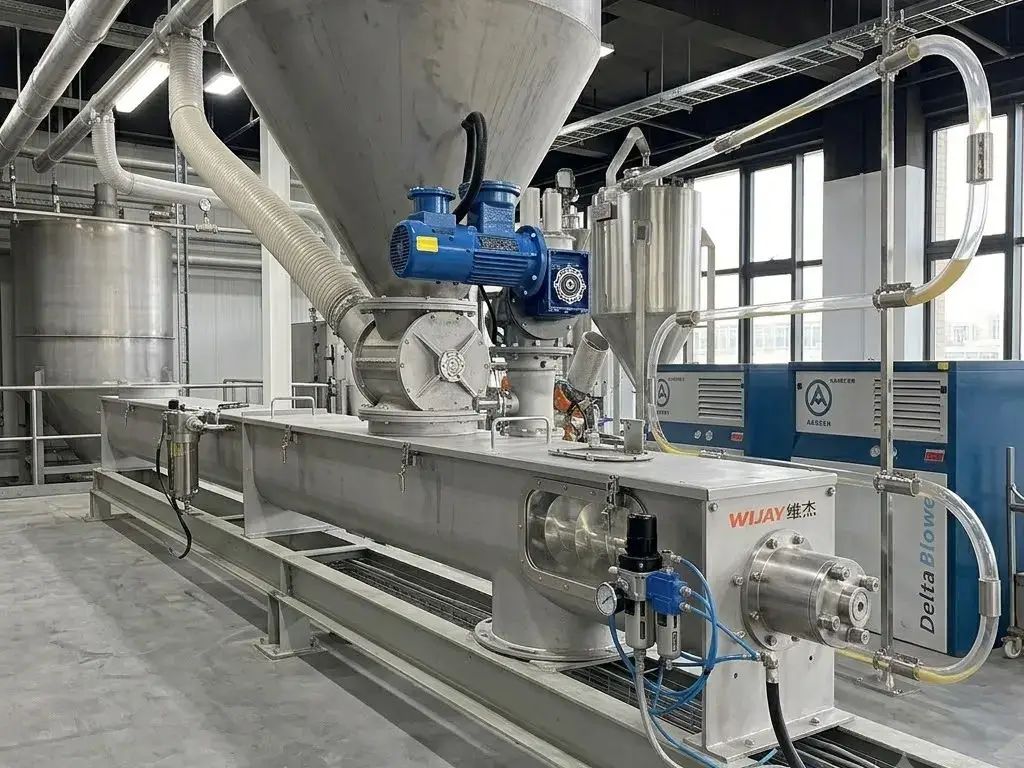
Silo geometry alone doesn’t guarantee reliable storage and discharge — discharge equipment has to complement the material’s actual behavior. A properly specified feeder needs to accomplish three things simultaneously: provide reliable, uninterrupted flow of material from the silo above; control the discharge rate to meet the process requirement while preventing uncontrolled flooding of fine powders; and remove material across the entire cross-section of the hopper outlet, since pulling material from only part of the outlet cross-section directly interferes with reliable mass flow discharge from the silo above it.
Engineering Storage and Discharge Systems Around Measured Material Behavior
The lesson from granulated sugar versus powdered sugar generalizes across every material a food processing plant handles: storage and discharge reliability isn’t a function of chemistry, silo size, or general industry practice — it’s a function of measured flow properties matched to silo geometry, outlet sizing, and feeder design specific to that material and its actual operating conditions. WIJAY Systems applies this same material-first approach across the bulk material handling and pneumatic conveying systems it designs, treating flow property characterization as a required input rather than an optional step, and matching hopper angle, outlet dimension, and feeder specification to the material’s actual measured behavior rather than a generic template borrowed from a different ingredient entirely.
For food processing facilities dealing with recurring bridging, ratholing, flooding, or product quality issues traced back to storage, that combination of measured material characterization and application-specific design is what actually resolves a geometry mismatch that discharge aids alone can’t fix.
FAQ
Why would two chemically identical materials behave completely differently in storage and discharge? Storage and discharge performance depends on measured flow properties — wall friction, cohesive strength, and compressibility — not chemical composition. WIJAY evaluates these material-specific properties for each application rather than assuming two chemically similar materials will behave the same way in a silo.
Can vibrators or air cannons fix a bridging or ratholing problem? Discharge aids can help in a properly designed system, but they rarely resolve a silo geometry that’s fundamentally mismatched to the material’s cohesive strength. WIJAY addresses the underlying geometry — hopper angle and outlet dimension — rather than relying on mechanical agitation to compensate for an undersized outlet.
What testing determines whether a silo will achieve mass flow? Wall friction shear testing determines the relationship between the material and the silo’s interior surface, which in turn determines the hopper angle required for mass flow. WIJAY specifies hopper geometry based on this measured data rather than industry rules of thumb that may not apply to a specific material.
Why does funnel flow cause more storage and discharge problems than mass flow? Funnel flow leaves stagnant material against the hopper walls, creating conditions for ratholing, segregation, and product quality loss from a first-in, last-out flow sequence — all of which mass flow eliminates by keeping the entire silo contents in motion. WIJAY evaluates flow pattern early in silo design specifically to avoid these structural failure modes.
Does a feeder matter as much as silo geometry for reliable discharge? Yes. A feeder must provide uninterrupted flow, control discharge rate without flooding fine powders, and pull material across the entire hopper outlet cross-section—pulling from only part of the outlet directly interferes with mass-flow discharge from the silo above. WIJAY specifies feeder design as an integrated part of the storage and discharge system, not a separate afterthought.