An explosion-proof pneumatic conveying system for hazardous material handling isn’t defined by a certification sticker on the equipment. It’s defined by whether the material actually stays contained, whether ignition sources are genuinely engineered out of the process, and whether the system holds up under real operating conditions — not just the conditions it was tested under. When you’re handling combustible dust, fine powders, or reactive chemicals, that distinction is the difference between a controlled process and a genuinely dangerous one.
This article walks through where traditional conveying methods fall short on hazardous material, what actually makes a pneumatic system safer by design, and what a plant should verify before assuming a system is doing its job.
What Counts as Hazardous Material Handling — and Why It’s Genuinely Risky
Hazardous material handling covers the transport and processing of substances capable of harming people, equipment, or the surrounding environment. In practice, that typically includes combustible dust (grain, sugar, certain chemicals, metal powders), toxic or ultra-fine powders, reactive or corrosive materials, and lightweight particles that become airborne easily.
The two risks that dominate this category are combustion and toxicity, and both are unforgiving. Combustible particles suspended in air can ignite under the right conditions and cause a serious explosion — dust explosions remain one of the more underappreciated industrial hazards precisely because the conditions that cause them (a fine dust cloud, an ignition source, confinement) can build up gradually and go unnoticed until the moment they don’t. Toxic materials carry a different but equally serious risk: they can be harmful if inhaled, and in some cases hazardous on contact with skin or eyes, which makes containment a worker-safety issue as much as a process one.
Where Traditional Conveying Falls Short
Mechanical conveying methods — belt conveyors, bucket elevators, screw conveyors — were largely developed before today’s safety expectations existed, and it shows. These systems are rarely dust-tight by design, which creates a predictable set of problems: open transfer points that release dust into the surrounding air, moving parts and friction points that introduce ignition risk, material spillage and buildup at transfer points, and cleaning requirements that are frequent, labor-intensive, and prone to missed spots.
The compounding effect of all four is what matters most: more dust accumulation, more worker exposure, and a higher baseline explosion risk — not because any single component failed, but because an open system creates more variables than a sealed one ever will.
What Actually Makes a Pneumatic System Safer
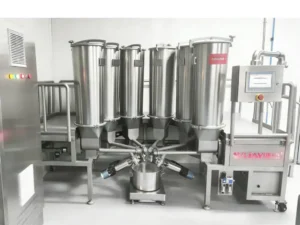
1. Fully enclosed, pressure-tight transport — not just dust-tight. There’s a meaningful difference between a system that’s “dust-tight” and one that’s genuinely pressure-tight. A well-engineered dense-phase pressure conveying system, paired with properly specified filtration at the receiving vessel, keeps material inside a sealed process from the feed point to the discharge point, with no meaningful pressure loss across the line. That containment does three things at once: it eliminates airborne dust clouds, it keeps the air workers actually breathe cleaner, and it isolates the process from ambient oxygen and humidity — which matters enormously for combustible materials, where an inert (nitrogen) atmosphere may be required, and for reactive materials, where keeping moisture out of the process is itself a safety requirement.
2. Ignition sources engineered out, not just managed around. A system built for hazardous duty should be designed to reduce or eliminate the conditions that cause ignition in the first place, not simply add protective measures after the fact. That typically includes explosion venting or suppression provisions where required, inert gas systems to reduce oxygen concentration in the process atmosphere, instrumentation rated for the facility’s hazardous area classification, and — critically — minimizing moving parts and mechanical friction points that can act as unintended ignition sources. This is particularly relevant in industries handling combustible dust as a routine part of production, where explosion prevention has to be designed in rather than bolted on.
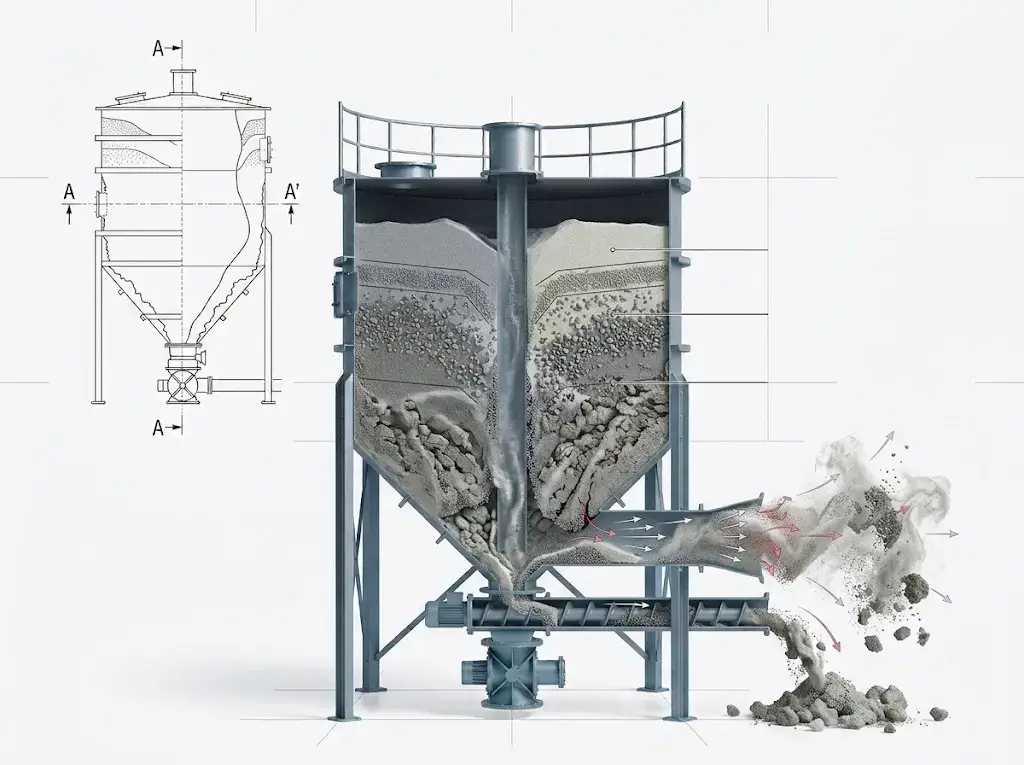
3. Reliability that doesn’t require opening the line. A pressure-tight system stops being pressure-tight the moment someone has to open piping to clear a blockage — and in a hazardous material process, that’s exactly the moment risk spikes. This is why plug prevention matters as much as containment itself: a well-designed dense-phase system actively manages airflow along the pipeline to keep material moving and prevent the kind of blockage that would otherwise force a technician to break containment mid-process. For most conveying applications, reliability is a production concern. For hazardous material handling, keeping the material inside the process without interruption is a safety requirement, not just an efficiency one.
4. Reduced worker exposure through automation. Sealed, automated pneumatic conveying means workers don’t need to be physically present near the hazardous process itself — monitoring and control can happen from a control room removed from the material path. That reduces exposure to toxic or fine airborne particles and lowers the ergonomic and physical risks that come with manual material handling. In industries where long-term exposure to airborne particulate is a genuine occupational health concern, this isn’t a secondary benefit — it’s often the primary reason the system gets specified in the first place.
Why Dense-Phase Conveying Is Often the Safer Choice
Not every pneumatic conveying design offers the same safety profile. Dense-phase conveying — which moves material at lower velocity and higher pressure than dilute-phase systems — carries several safety-relevant advantages: less particle degradation, which means less dust generation both in transit and at the receiving vessel; minimal equipment wear, which extends maintenance intervals and reduces how often the line needs to be opened at all; and lower conveying gas consumption, which makes inert gas (nitrogen) conveying genuinely practical and economical for combustible materials rather than prohibitively expensive.
For facilities where dust control and explosion prevention are primary design drivers — not secondary considerations — dense-phase conveying is frequently the better-suited technology.
Best Practices Beyond the Equipment Itself
Even a well-engineered system needs the right process and procedures behind it. A few practices worth treating as non-negotiable:
- Conduct a Dust Hazard Analysis (DHA) before finalizing system design, not after installation.
- Properly ground all equipment to eliminate static discharge as an ignition source.
- Install explosion protection systems — venting, suppression, or isolation — wherever the hazard analysis calls for them.
- Determine hazardous area classification for the full facility, not just the immediate conveying equipment — the hazard sometimes originates from a nearby process rather than the material being conveyed itself.
- Train personnel on safety protocols specific to the hazardous material and the equipment handling it, not just general plant safety training.
Safety in hazardous material handling isn’t one feature you add to a system. It’s a system-wide approach that has to be designed in from layout through commissioning.
Getting the Design Right the First Time
The safest pneumatic conveying system isn’t necessarily the one that moves material fastest or cheapest — it’s the one that protects everything around it: the people on the floor, the surrounding facility, and the process itself. Getting that right requires treating containment, ignition prevention, and reliability as interconnected design requirements, not separate checkboxes to satisfy after the fact.
FAQ
How does pneumatic conveying reduce combustible dust risk compared to mechanical systems? By isolating the conveying process from the plant environment so dust can’t escape into the surrounding air. That containment reduces dust accumulation on nearby surfaces, lowers ignition risk, and generally results in a cleaner, safer working environment than an open mechanical conveyor allows.
What’s the difference between dense-phase and dilute-phase pneumatic conveying? Dense-phase conveying moves material in discrete, low-velocity slugs, which reduces both material degradation and wear on pipeline components. Dilute-phase conveying suspends material in a faster-moving airstream, which can move product quickly but typically generates more particle degradation and equipment wear over time.
Is pneumatic conveying actually safer than mechanical conveying for hazardous materials? Generally, yes. Enclosed pneumatic systems significantly reduce dust emissions, contamination, and worker exposure compared to belts or screw conveyors. Dense-phase systems in particular eliminate the chains, sprockets, belts, rollers, and augers that represent both mechanical and ignition hazards in traditional conveying equipment.
What kinds of hazardous materials are typically handled with pneumatic conveying? A wide range — combustible dust, toxic powders, fine chemicals, ash, metal powders, and plastic resins are all common applications. Pneumatic conveying is particularly well suited to materials that need to be handled in a fully enclosed, dust-free, and controlled environment.
Does an explosion-proof rating on individual components guarantee a safe system overall? Not on its own. Component-level certification matters, but system-level safety depends on containment integrity across the full material path, ignition-source elimination in the mechanical design, correct hazardous area classification for the whole facility, and procedural safeguards like grounding and staff training. A system built from certified components can still carry meaningful risk if these are treated separately instead of as one integrated design.
If your facility is still relying on open or mechanical conveying for a genuinely hazardous material, that’s a risk worth revisiting before it becomes an incident report. WIJAY Systems designs enclosed, dense-phase pneumatic conveying systems for combustible dust, toxic powders, and reactive materials across chemical, food, plastics, and other bulk material industries — engineered around containment and reliability from the first layout, not added on afterward. If you’d like a second opinion on a hazardous material handling process, our process engineering team is glad to talk it through.