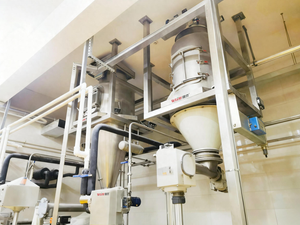
In food production, the efficiency and accuracy of raw material handling directly determine both output capacity and product quality. For this customer—who specializes in canned and ready-to-eat pouch foods with hundreds of product SKUs—traditional manual batching is no longer able to meet the demands of multi-product, multi-formula manufacturing.
Manual material feeding often causes spillage, uneven mixing, and inconsistent dosing. These issues slow production, compromise recipe accuracy, and create unhygienic work environments that fail to meet food safety standards, ultimately limiting the company’s ability to scale operations.
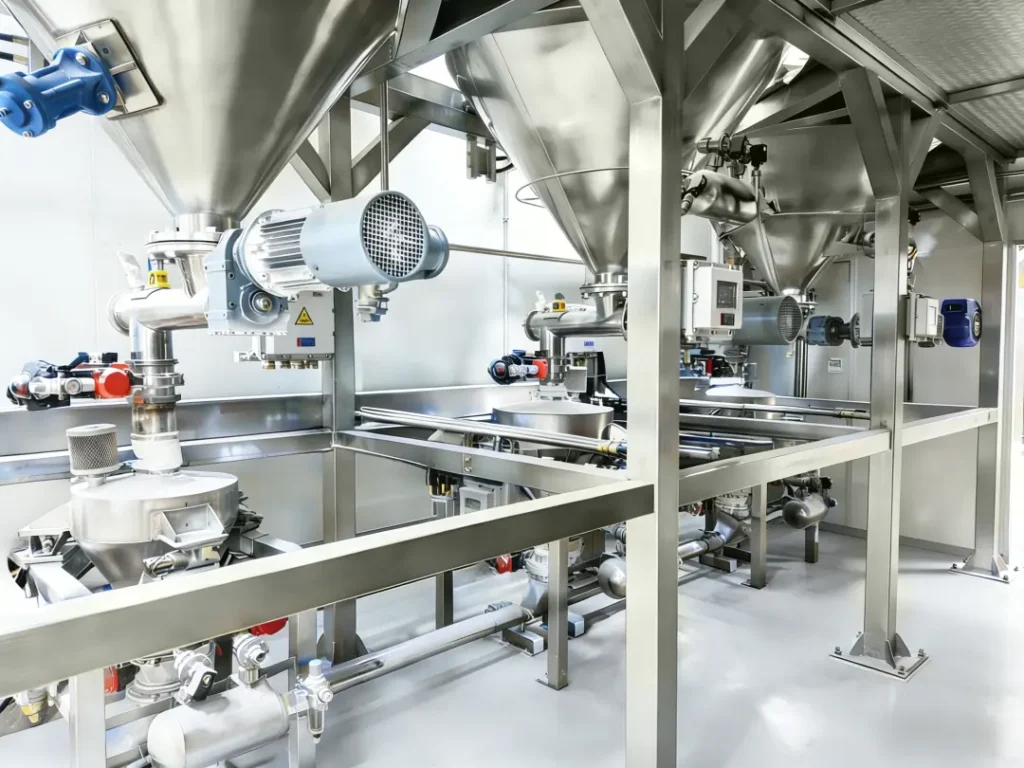
Industry Challenge: Why Manual Batching Fails at Scale
Manufacturers running 10 or more active product formulas face compounding problems with manual ingredient handling:
- Operators manually weigh and transfer up to 18 raw materials per batch, including sugar, salt, citric acid, and starch — each with distinct flow characteristics and varying sensitivity to cross-contamination.
- Batch-to-batch variation caused by human error creates quality inconsistencies across product lines.
- Open-transfer processes generate dust and spillage, violating food-grade hygiene standards and creating housekeeping costs.
- Line throughput is limited by the slowest manual step, not by equipment capacity.
For this client — producing meat, seafood, vegetarian, and condiment product lines — these issues were compressing margins and limiting their ability to scale.
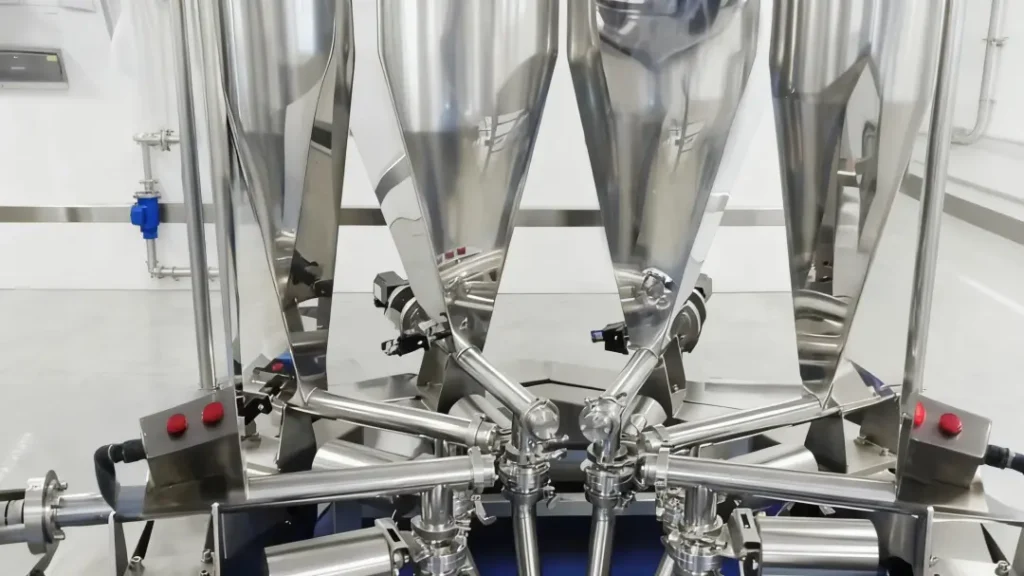
Two-Module Automated Raw Material Handling Architecture
Rather than applying a generic system, Wijay conducted on-site process audits across all product categories before specifying equipment. The result was a two-module system addressing distinct material types and flow requirements.
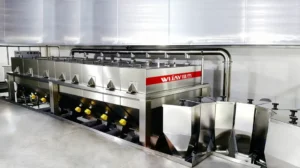
Module 1 — Small and Medium Ingredient Auto-Batching Handles 18 commonly used raw materials across 10+ product formulas. The module integrates:
- Indoor feeding stations with enclosed transfer paths
- Dedicated small/medium ingredient feeding stations
- Downstream weighing zone with automated recipe dispatch
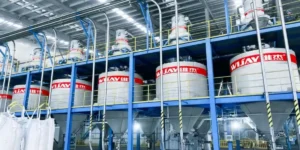
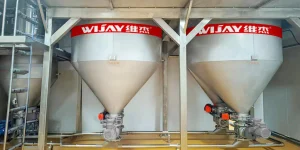
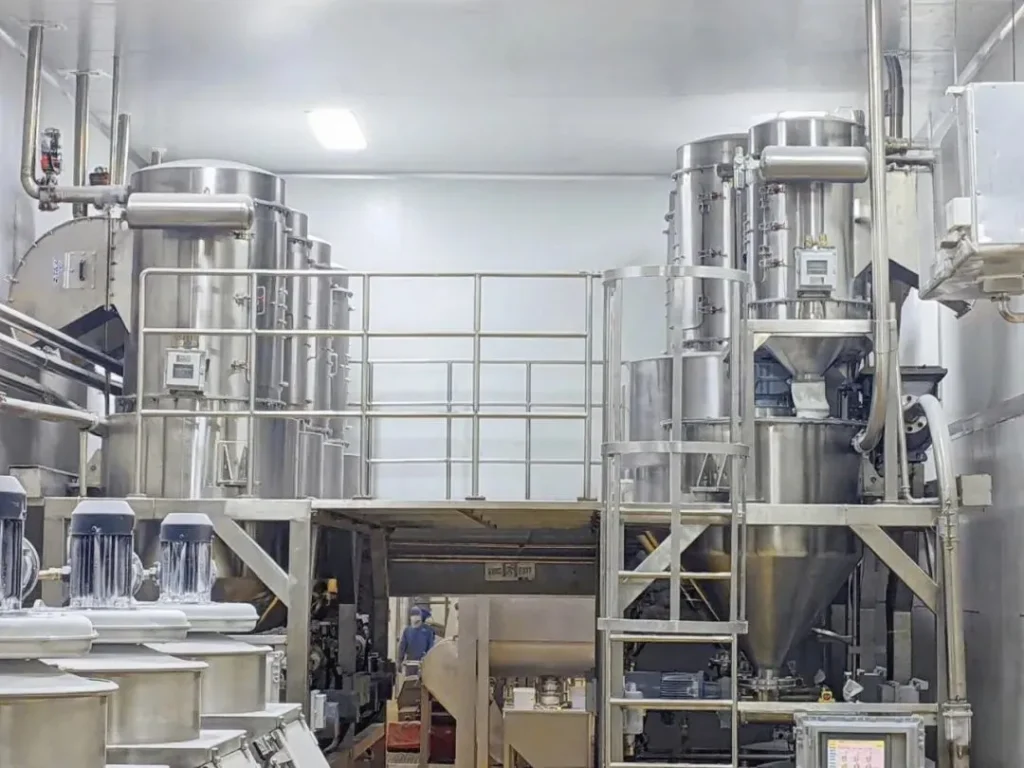
Module 2 — Corn Starch Automated Handling Designed for high-volume, long-distance starch supply:
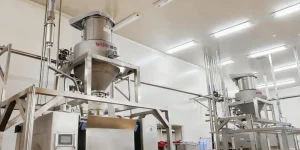
- Dual-input screening and feeding station (ton-bag and small-bag compatible)
- Large-capacity outdoor storage silo
- Automated weighing module with closed conveying path
- Conveying range: up to 100 meters horizontal, up to 12 meters vertical
Key Technical Highlights
- Batching speed: 3 minutes per batch — enabling continuous production without inter-batch idle time
- Weighing accuracy: ±0.3% — meeting strict formula tolerances across all 10+ product lines
- Conveying capacity: up to 100m horizontal / 12m vertical for starch, accommodating plant layout constraints.
- Fully enclosed transfer: eliminates dust emissions and cross-material contamination throughout the system.
- Multi-formula flexibility: recipe parameters are configurable per product line, with no manual retooling between changeovers
Operational Results and Business Value
Following system commissioning, the client reported measurable improvements across three operational dimensions:
Production efficiency: Batching time per cycle dropped to 3 minutes. Manual labor involvement in ingredient handling was significantly reduced, freeing operators for quality and line oversight roles.
Ingredient precision and product consistency, ±0.3% weighing accuracy, standardized formula execution across all product lines. Batch-to-batch variation — previously a source of rework and quality holds — was eliminated for all 18 handled ingredients.
Hygiene compliance and workplace environment. Enclosed automated transfer removed the primary sources of dust and spillage from the production floor. The system directly supports conformance with food manufacturing hygiene regulations and reduces the risk of regulatory findings during facility audits.
Cost structure: Reduced manual labor per batch, lower material loss from spillage, and fewer rework events contribute to measurable per-unit cost reduction — without capital expenditure on expanded floor space.
Why Wijay for Food Production Raw Material Handling
Wijay engagement model begins with on-site process documentation, not product catalogues. For this project, the team mapped ingredient types, formula structures, conveying distances, and hygiene zone requirements before any equipment was specified.
Capabilities relevant to food manufacturers:
- Dual-input handling (ton-bag and small-bag) within a single system
- Long-distance pneumatic conveying for bulk powder ingredients
- Recipe-level automation compatible with multi-SKU production environments
- Full project scope: engineering design, equipment selection, installation, commissioning, and post-handover technical support