Somewhere in almost every pneumatic dense-phase conveying system project, the same design decision comes up: do you feed the line from a pressure vessel, or from a high-pressure rotary valve? It gets treated like a simple either/or choice more often than it should. It isn’t. It’s a trade-off between capital cost, throughput continuity, conveying distance, and how forgiving your material actually is — and getting it wrong shows up later as either unnecessary downtime or a system that never hits rated capacity.
Dense-phase conveying itself is defined by high material loading (solids-to-gas ratio above roughly 25:1) and low gas velocity, which is exactly what keeps pipeline wear and energy consumption down compared to dilute-phase systems. Inside that framework, though, how you feed material into the line — batch or continuous — changes almost everything downstream.
The Fundamental Difference: Batch Operation vs. Continuous Feed
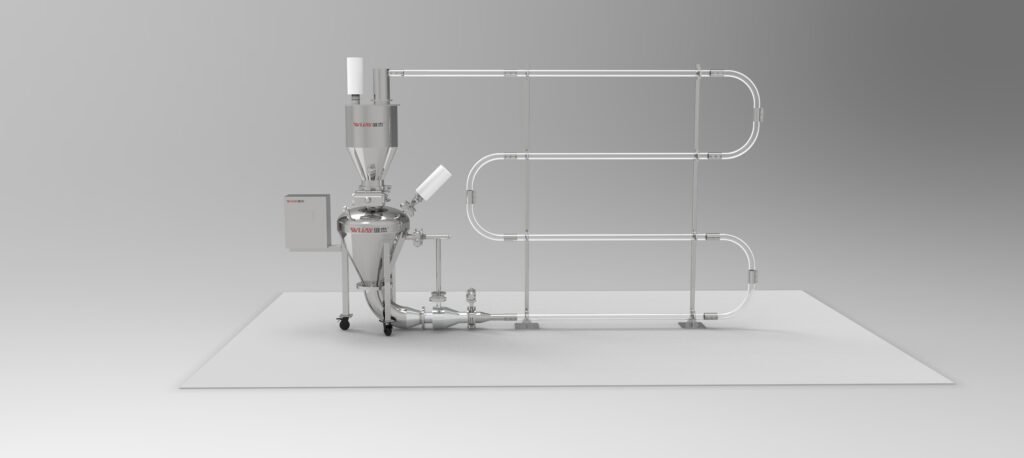
A pressure vessel runs on a batch cycle. Material loads into the vessel, the vessel seals, compressed air pushes the batch out through the line, and the vessel depressurizes before the cycle repeats: fill, pressurize, discharge, vent. Inside the pipeline, material moves as a fluidized plug or slug flow — the classic dense-phase transport pattern.
A high-pressure rotary valve does the opposite: it feeds continuously. A rotating rotor meters material from atmospheric pressure into the pressurized conveying line at a steady, controlled rate, with no interruption. Beyond metering, the rotor also functions as an airlock — maintaining the pressure differential between the low-pressure and high-pressure sides of the system, which is what keeps line pressure stable in the first place.
Head-to-Head: The Numbers That Actually Drive the Decision
Operating pressure. Pressure vessels typically run 0.5–0.7 MPa, giving them a real pressure advantage over rotary valve systems, which are generally rated around 0.35 MPa (3.5 bar) — though some specialized high-pressure rotary valve designs push higher.
Conveying distance. Pressure vessels handle long-distance conveying reliably — 100 to 1,000 meters is a realistic operating range. Rotary valve feed is generally the better fit for short-to-medium distances, typically under 100 meters.
That pressure gap is the whole story behind the distance gap: higher line pressure is what lets a pressure vessel push material further before it runs out of driving force.
Where the Pressure Vessel Wins — and Where It Doesn’t
The pressure vessel’s biggest advantage is long-distance capability, which comes directly from its higher operating pressure. Because dense-phase transport velocity stays low, product degradation is minimal — which matters a lot if you’re conveying friable or highly abrasive material. As a fully sealed batch system, there’s no continuous gas leakage path, which keeps energy efficiency high. Mechanically, it’s also a simpler system, and initial capital cost is typically lower than a comparable rotary valve setup.
The trade-off is the batch cycle itself. Fill, pressurize, discharge, and vent all take time, and that cycle creates dead time between batches that a continuous-feed system doesn’t have. Physically, pressure vessels and their associated valve trains also need more floor space than a rotary valve installation.
Where the High-Pressure Rotary Valve Wins — and Where It Doesn’t
The rotary valve’s core strength is continuous, uninterrupted feed — steady output with no batch gaps, which translates directly into stable overall throughput. In continuous-duty operation, total conveying capacity is strong, which makes rotary valves a solid fit for high-volume production. The mechanical footprint is also simpler and more compact, which makes automation and control integration more straightforward.
The limitations run in three directions. First, the clearance between rotor and housing allows some high-pressure-side gas to leak back to the low-pressure side, which reduces efficiency and can interfere with material discharge if not controlled. Second, sticky or friable materials are a poor match — the rotating vanes can damage particles or simply won’t handle the material reliably. Third, precision-machined, high-pressure rotary valves cost more to manufacture than a comparable pressure vessel. That said, modern multi-stage sealing designs bring leakage rates below 0.1%, and pressure-rated rotary valves are now built to hold differentials above 0.6 MPa — figures worth checking against, not assuming, when you’re evaluating a supplier’s spec sheet.
Typical Application Fit
Pressure vessels are the better fit when: conveying distance exceeds 100 meters; the material is friable or highly abrasive — quartz sand and plastic pellets are common examples; the process itself calls for batch operation; or the system layout is multiple feed points into a single receiving point.
High-pressure rotary valves are the better fit when: the process needs continuous, high-volume feed; conveying distance is moderate, generally under 100 meters; the material flows well and isn’t prone to breaking down; or the layout is a single feed point serving multiple receiving points across a more complex pipe network.
Four Questions That Actually Settle the Selection
1. Is your process continuous or batch? If material has to feed 24/7 without interruption, a rotary valve’s continuous feed isn’t something a batch system can substitute for. If the process is already run in batches, or batch operation is acceptable, a pressure vessel is generally the more economical choice.
2. How far are you actually conveying? For distances running into the hundreds of meters or more, the pressure vessel’s higher operating pressure is a clear advantage. For runs in the tens of meters up to roughly 100 meters, a high-pressure rotary valve handles it comfortably.
3. What are the material’s actual properties? Friable materials (food and pharmaceutical products, for example) or highly abrasive ones (quartz sand) are safer conveyed at the lower velocity a pressure vessel provides. Free-flowing, uniform, durable particles are a strong fit for rotary valve efficiency. Some materials — carbon black in dense-phase transport is a good example — can run reliably on either system, which means the deciding factor shifts to secondary characteristics. This is exactly where projects go wrong: over 60% of powder conveying system failures in the field trace back to inadequate material characterization before selection — not equipment defects. Bulk density, angle of repose, moisture content, flowability index, abrasiveness, and corrosivity all need to be measured on the actual material before you finalize a spec, not assumed from a datasheet.
4. What’s the project budget? High-pressure rotary valve systems typically carry a higher upfront investment. If budget is constrained and other conditions allow, a pressure vessel has the initial-cost advantage. But a rotary valve’s continuous, high-efficiency operation can offset that gap over time through higher sustained throughput — a comparison worth running as total cost of ownership, not just capex.
Where This Technology Is Headed
Neither system is displacing the other — dense-phase conveying is moving toward using each one where it’s genuinely the better fit, with both technologies continuing to advance on their own strengths.
Pressure vessel development is focused on:
- Ultra-long-distance conveying (1,000–3,000 m)
- Ultra-high pressure ratings (6–10 bar)
- AI-optimized cycle timing
- Multi-vessel parallel configurations
- Intelligent valve control
High-pressure rotary valve development is focused on:
- Ultra-low leakage (under 0.5%)
- Automatic clearance compensation
- Online wear monitoring
- Tungsten carbide, ceramic, and other wear-resistant materials
- AI-based predictive maintenance
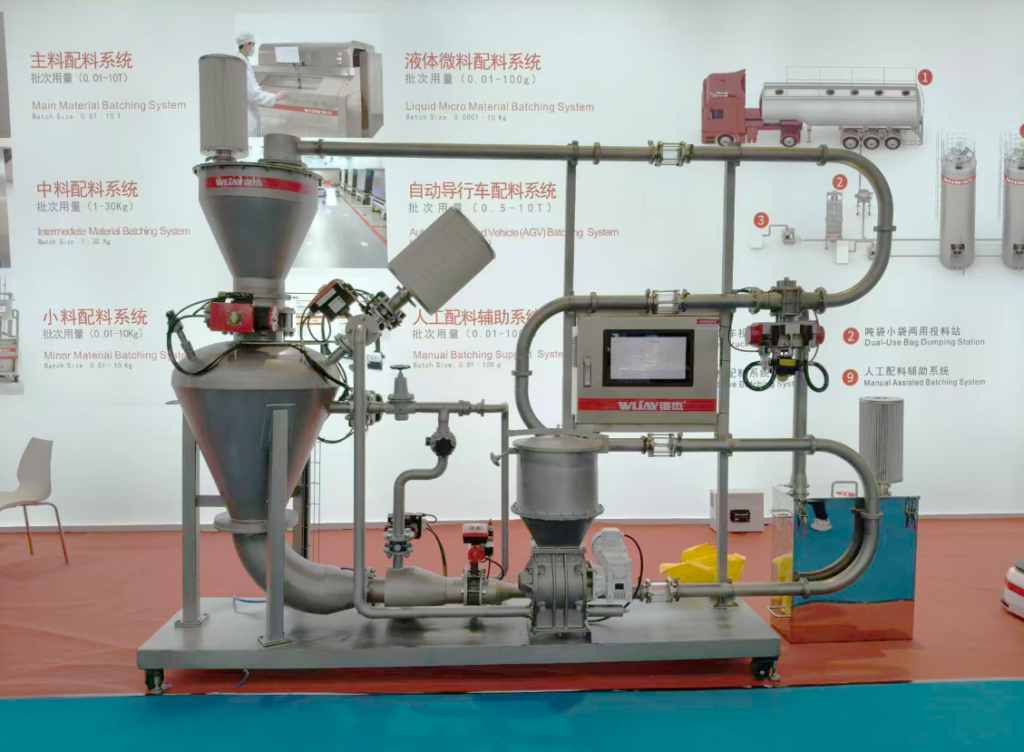
It’s also worth noting that hybrid configurations already exist in the field — using a pressure vessel as a buffer feeding into a high-pressure rotary valve, combining the strengths of both rather than forcing a single-technology choice.
The Bigger Picture: This Isn’t Just a Feeder Decision
A pneumatic dense-phase conveying system is more than its feed mechanism — air supply equipment, conveying line design, filtration and separation, and control architecture all have to match for the system to run reliably long-term. A feeder chosen in isolation, without testing it against your actual material and layout, is one of the most common root causes of underperforming systems.
That’s why material testing and system design should happen together, early, with an integrator who’s actually run the tests — not applied a rule of thumb from a similar-sounding application.
FAQ
Is a pressure vessel or rotary valve better for long-distance dense-phase conveying? Pressure vessels, generally. Their higher operating pressure (0.5–0.7 MPa vs. roughly 0.35 MPa) is what makes 100- to 1,000-meter conveying distances achievable, where rotary valve systems typically top out under 100 meters.
Can a high-pressure rotary valve handle abrasive or friable materials? Not reliably in most cases. The rotating vanes can damage friable particles, and abrasive material accelerates wear on the rotor and housing. A pressure vessel’s lower conveying velocity is generally the safer choice for these materials.
How much does rotary valve leakage actually affect performance? Standard clearances allow some high-pressure gas to leak back to the low-pressure side, reducing efficiency. Multi-stage sealed rotary valves bring that below 0.1%, so leakage rate is a spec worth verifying directly rather than assuming from the valve category alone.
Why does material testing matter so much in feeder selection? Because feeder performance depends on real material behavior — bulk density, moisture, flowability, abrasiveness — not on a generic material name. Field data shows a majority of powder conveying failures trace back to insufficient material characterization before the system was specified, not to equipment quality.
Can pressure vessels and rotary valves be combined in one system? Yes. A common hybrid configuration uses a pressure vessel as an intermediate buffer feeding a downstream rotary valve, combining the pressure vessel’s distance capability with the rotary valve’s continuous discharge.
WIJAY Systems designs pneumatic dense-phase conveying systems as fully integrated lines — enclosed, dust-free, low-degradation material handling engineered around your actual material properties and layout, not a generic feeder recommendation. If you’re specifying a new dense-phase line, or trying to work out why your current feeder isn’t hitting rated throughput, that’s a conversation worth having with our process engineering team before the next spec revision.