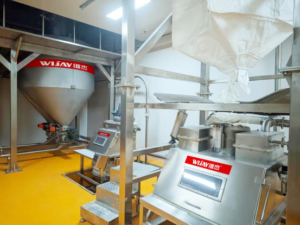
If you run a bakery, confectionery, or snack production line, you already know the real cost of open-chute powder handling. It isn’t listed on any P&L line item labeled “manual dosing,” but it shows up everywhere else: in the sugar dust coating your rafters, in the 2–3% raw material shrinkage nobody can fully explain, in the batch that came out slightly off-spec because an operator eyeballed the last scoop.
Sound familiar? You’re not alone. Across bakery and confectionery plants that still rely on open hoppers and manual weighing, three problems repeat almost identically: airborne dust that triggers housekeeping and compliance headaches, weighing variance that erodes product consistency, and a labor bill that scales linearly with output — because open dosing simply can’t run itself.
This article breaks down why these losses happen, what the current food-manufacturing standard actually requires, and how a fully enclosed pneumatic conveying system re-engineers powder handling from raw material intake to finished batch — without the dust, without the guesswork, and without adding headcount every time you scale.
Why Open-Chute Powder Dosing Fails at Scale
Dust Isn’t Just a Housekeeping Problem
Fine powders — icing sugar, wheat flour, starch, milk powder — become airborne the moment they’re poured, scooped, or dropped through an open chute. Beyond the visible film on equipment, this creates two measurable risks: combustible dust accumulation in enclosed spaces, and microbial cross-contamination from airborne particulate settling on exposed product downstream. Plants running open dosing routinely report dust levels that require additional filtration retrofits just to stay within workplace exposure limits — an unplanned capital cost that a sealed system avoids entirely.
Manual Weighing Doesn’t Scale With Precision
A skilled operator weighing by hand typically introduces batch-to-batch variance in the range of 3–8%, depending on ingredient flowability and fatigue over a shift. In a bakery formulation, that variance directly changes texture, sweetness, and shelf behavior — meaning quality control either rejects more finished product or lets inconsistency reach the customer. Neither outcome is acceptable at commercial volume.
Labor Cost Scales With Output — It Shouldn’t
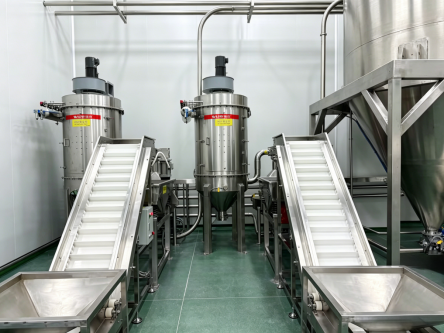
Open dosing requires an operator at every transfer point: bag opening, chute feeding, hopper monitoring, batch confirmation. As throughput increases, so does headcount. For most mid-size food plants, this means dosing labor represents one of the least automatable line items on the production floor — until the material handling itself is redesigned.
Downtime From Clumping and Blockage
Hygroscopic powders like sugar and starch clump under humidity and vibration, causing chute blockages that stop the line. Unscheduled downtime from material handling failures is one of the most under-tracked costs in food manufacturing — it rarely appears as its own line item, but it compounds across shifts.
What the Industry Standard Actually Requires
Modern food-grade material handling is judged against a few non-negotiable benchmarks: HACCP-aligned sanitation with no dead zones for microbial growth, CIP (clean-in-place) capability so the system can be sanitized without disassembly, sealed transport that prevents both product loss and airborne contamination, and weighing accuracy tight enough to eliminate manual correction. Open-chute systems were never designed to meet these benchmarks simultaneously — they were designed before these benchmarks existed.
How a Closed-Loop Pneumatic Conveying System Solves This
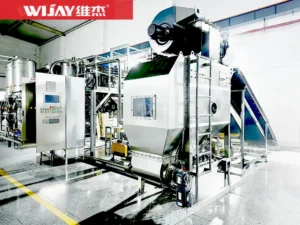
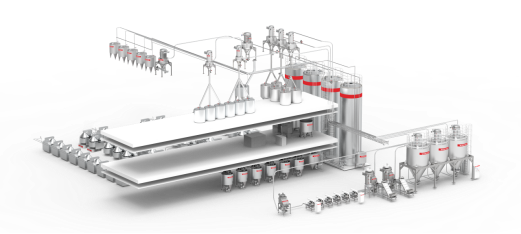
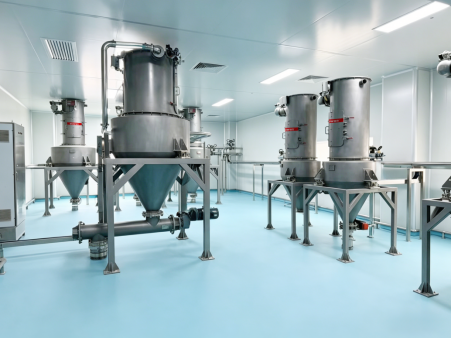
WIJAY Systems engineers fully enclosed pneumatic conveying and automated dosing lines specifically for powder-intensive food production — sugar, icing sugar, flour, starch, milk powder, and granular food additives. Sixteen years of field deployment across bakery, confectionery, and snack manufacturers, backed by more than 100 in-house patents, has shaped a system built around five operational priorities.
1. Fully Enclosed, Dust-Free Material Transport
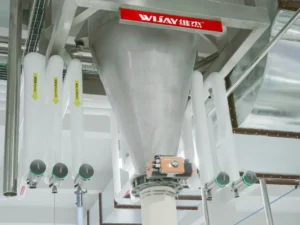
The system runs positive-pressure, negative-pressure, or dense-phase conveying depending on material characteristics, moving powder through sealed piping from intake to dosing point. No open chutes, no airborne loss, no manual scooping. Integrated food-grade dust collection captures any residual particulate at the source, and the entire line supports CIP sanitation with no cleaning dead zones — meeting HACCP requirements without manual teardown. For sugar-specific lines, grinding and drying units can be integrated directly into the conveying path, handling raw sugar intake, milling, and pneumatic transport as a single continuous process.
2. End-to-End Automation From Bulk Bag to Finished Pack
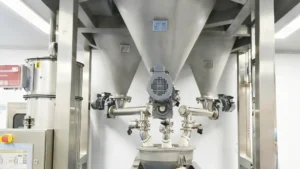
The line automates bulk bag unloading, buffer storage, precision weighing, dosing, and final packing in sequence. A single production line typically runs on 1–2 operators for monitoring rather than manual material handling — cutting labor cost by roughly 20% and lifting overall line throughput by a comparable margin. Scaling output no longer means scaling headcount at the same rate.
3. High-Precision Automated Weighing
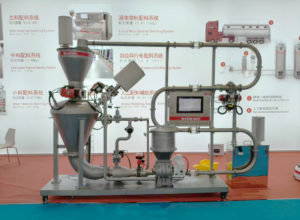
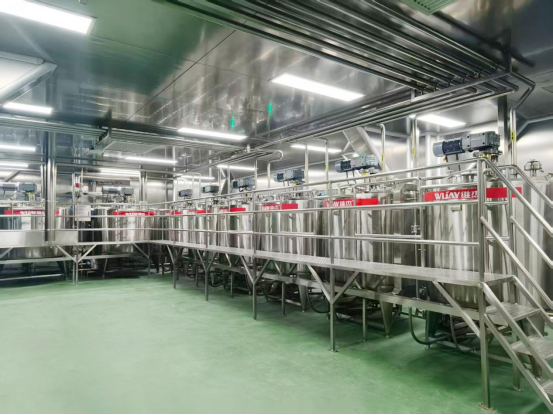
A proprietary weighing and metering module holds dosing accuracy to within 2%, with the capacity to store multiple standardized recipes and switch between them automatically. This removes manual weighing variance entirely, stabilizing flavor and texture batch-to-batch and reducing the reject rate tied to off-spec formulation. A Siemens HMI control interface layers on production data traceability, automatic fault alarms, and one-touch recipe switching — built for plants that need digital process records, not just automation.
4. Multi-Material, Multi-Line Flexibility
The platform handles granulated sugar, icing sugar, cake flour, starch, milk powder, and a range of food additives and granular ingredients, with configurations built around a plant’s throughput target, floor layout, and conveying distance. Deployments to date span 20–30 t/h processing capacity, with horizontal conveying runs exceeding 300 meters and vertical lift up to 150 meters, supporting multiple simultaneous feed points across parallel production lines. Systems are engineered equally for retrofitting an existing plant’s bottleneck section or specifying a complete new-build facility.
5. Field-Proven, Not Theoretical
Every configuration above reflects deployed projects, not lab specifications — informed by direct engineering exposure to bakery, confectionery, and snack production environments and their recurring failure points.
Frequently Asked Questions
What is a pneumatic conveying system used for in food manufacturing? It transports powdered or granular ingredients — sugar, flour, starch, milk powder, additives — through sealed piping using air pressure, eliminating open-chute handling, dust exposure, and manual scooping between storage, weighing, and packing stages.
How much does pneumatic conveying reduce material loss compared to manual dosing? Because material never leaves the sealed pipeline until it reaches the dosing point, spillage and airborne loss that typically accompany open-chute transfer are essentially eliminated, directly reducing raw material shrinkage.
Can a pneumatic conveying system meet HACCP requirements? Yes — when the system supports CIP (clean-in-place) sanitation with no internal dead zones, it aligns with HACCP clean-production standards, which open-chute systems generally cannot meet without extensive manual disassembly.
Is pneumatic conveying suitable for retrofitting an existing plant? Yes. Systems can be scoped to automate a single bottleneck section of an older facility, or designed as a full-line solution for a new build — conveying distance and capacity are configured to the existing floor layout.
What dosing accuracy can automated pneumatic systems achieve? Field-deployed systems with integrated weighing modules commonly hold dosing precision within 2%, compared to 3–8% variance typical of manual weighing.
Where This Leaves Your Production Line
Open-chute dosing was never built for the volume, precision, and sanitation standards food manufacturing now runs on. The cost isn’t always visible on a single invoice — it’s distributed across dust remediation, rejected batches, idle-but-necessary labor, and unplanned downtime. A fully enclosed pneumatic conveying and dosing system addresses all four at the structural level, not with a patch.
If you’re evaluating where powder handling is quietly costing your line — in loss, in labor, or in inconsistency — WIJAY Systems can walk through your current process, material characteristics, and throughput target to scope a configuration suited to your plant. [Talk to our process engineering team →]