If you run a bakery, snack, or dry-mix production floor, you already know where the money disappears. It’s not on the line — it’s in the gap between the powder silo and the mixer.
Open-chute transfer. Manual scooping between hoppers. A trail of flour dust settling on beams, motors, and floor drains that someone has to clean before the next shift can even start. None of it shows up as a single line item on a P&L, but it adds up: product loss you can’t reclaim, batch-to-batch flavor drift your QA team keeps flagging, and a dust load that’s one static spark away from becoming an OSHA combustible-dust incident.
We’ve walked enough food production floors to recognize the pattern immediately. Multiple SKUs, multiple powder ingredients — flour, sugar, maltodextrin, milk powder, functional additives — each with different flow characteristics, each vulnerable to moisture pickup, caking, and cross-contamination the moment it’s handled in an open environment. Manual dosing compounds the problem: even a well-trained operator introduces ±2–4% variance per batch, which is enough to shift texture and taste across a production run that’s supposed to be identical from bag one to bag one thousand.
This is the operational reality that makes a properly engineered pneumatic conveying system the backbone of modern powder automation — not a single machine bolted onto an existing line, but the connective infrastructure that ties intake, storage, weighing, and dosing into one closed-loop process.
Why Open-Transfer Powder Handling Fails at Scale
Most facilities don’t set out to run an inefficient process. They scale gradually — adding SKUs, adding shifts, adding tonnage — until the manual handling methods that worked at a smaller volume start generating measurable losses:
- Dust loss and combustible dust risk. Airborne flour and sugar dust is a documented explosion hazard in food processing (NFPA 61 exists for a reason), and every gram that escapes into the air is a gram you paid for and didn’t sell.
- Moisture ingress and caking. Milk powder, malt-based ingredients, and hygroscopic additives absorb ambient humidity fast when exposed during open transfer, degrading flow properties and shelf stability before they ever reach the mixer.
- Cross-contamination exposure. Open hoppers and manual transfer points are entry paths for insects, foreign debris, and allergen cross-contact — a growing compliance liability under FSMA and equivalent frameworks.
- Labor-driven batch variance. Manual weighing and dosing depend on operator consistency shift to shift. Multiply small errors across a multi-ingredient recipe and the finished product drifts in ways your customers notice before your QA data does.
- Unplanned downtime. Clogged transfer points, blocked chutes, and manual cleanup between batches eat into uptime that a sealed, automated system simply doesn’t lose.
None of these are visible on a single day’s output report. They show up cumulatively — in yield reports, in QA rejection rates, in the maintenance log for dust collection equipment that’s fighting a losing battle.
What a Properly Engineered Pneumatic Conveying System Actually Solves
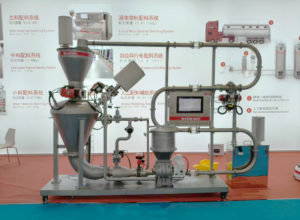
A pneumatic conveying system moves bulk powder through a sealed pipe network using controlled airflow, rather than gravity chutes, screw conveyors, or manual transfer. Done right, it does three things a manufacturer can measure directly against their current losses.
1. Fully Enclosed Transfer Eliminates Dust and Product Loss
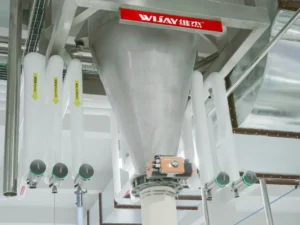
Food-grade stainless steel piping keeps material inside a closed system from intake to discharge — no open transfer point, no airborne dust, no material settling on equipment or in the workspace. For high-value ingredients like milk powder or specialty additives, this alone can represent a meaningful reduction in raw material waste over a production year, and it removes a recurring combustible-dust housekeeping burden from your safety program.
2. Throughput That Matches Real Production Demand
A well-specified system should handle up to 12 tons per hour, using dilute-phase or dense-phase conveying configured to the specific flow characteristics of the powder — bakery flour behaves differently under airflow than fine sugar or milk powder, and a system that isn’t tuned to that difference will underperform or clog. Adequate throughput headroom matters most during peak production windows, when multiple lines are drawing material simultaneously and any bottleneck at the conveying stage cascades downstream to mixing and forming.
3. Long-Distance Routing Without Losing Layout Flexibility
Large-format food plants routinely need to move material 100 meters or more between storage and dosing points, often around structural columns, mezzanines, and existing production equipment. Sealed pipe routing gives engineering the flexibility to plan around a facility’s real layout constraints instead of forcing a new floor plan around a rigid conveyor line — a meaningful advantage when retrofitting an existing plant rather than building new.
Beyond the Pipe: Why Conveying Has to Be Part of a Closed-Loop System
Here’s where a lot of powder handling projects fall short: a pneumatic conveying line installed as a standalone unit still leaves the temperature control, batch weighing, and recipe management as separate procurement problems. The plant ends up integrating disparate equipment from multiple vendors, and integration gaps are exactly where dust ingress, moisture exposure, and calibration drift creep back in.
A closed-loop architecture solves this by treating conveying as one stage in a continuous process:
Intake and pre-treatment — Bagged powder enters through a dust-contained station with vibratory screening to remove clumps, fiber, and foreign material before it ever reaches the pipe network.
Sealed pneumatic transfer — Material moves through the enclosed line to climate-controlled storage, with zero exposure to ambient air.
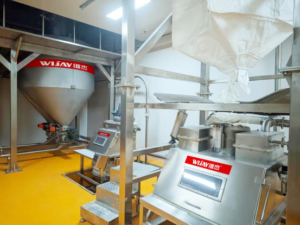
Temperature- and moisture-controlled storage — Hygroscopic ingredients like flour, milk powder, and sugar are held in independently monitored tanks with real-time humidity and temperature tracking, preventing the caking and degradation that occurs in uncontrolled storage.
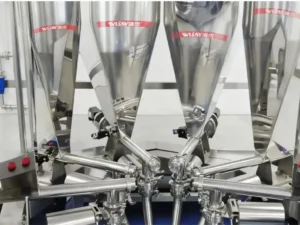
Multi-tank precision weighing — Independent load-cell-equipped tanks (a properly specified system can run 7 or more in parallel) allow each ingredient to be dosed to its own recipe parameters, with PLC-controlled batching that holds tolerances a manual process can’t match.
Recipe-driven automation — Formula switching happens at the touch panel, not by reconfiguring equipment. New SKUs mean new stored recipes, not new hardware.
Traceability and monitoring — Fill levels, flow rates, tank temperatures, and dosing records are logged automatically, supporting the batch traceability documentation that food safety audits require.
This is the difference between buying a conveying machine and commissioning a conveying system. The pipe is the artery; the value is in what it connects.
What This Looks Like in Practice
On a recent multi-line bakery automation project — a facility running parallel SKUs including artisan breads, sandwich loaf, cakes, and pastry lines, each with distinct flour, sugar, maltodextrin, milk powder, and additive formulations — the engineering brief was straightforward on paper and demanding in execution: eliminate manual dosing variance across formulations, cut dust exposure to near zero, and support formula changeovers without production stoppages.
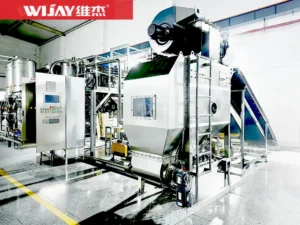
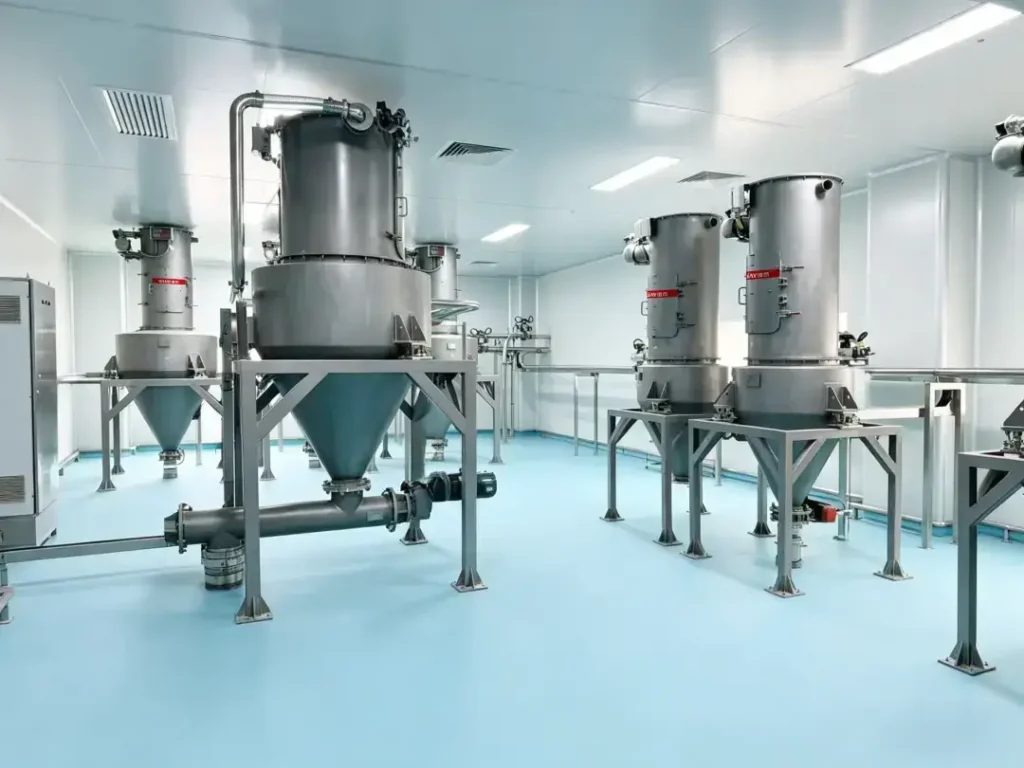
The resulting system delivered 12t/h conveying capacity across dense- and dilute-phase configurations, sealed pipe runs up to 100 meters connecting storage to the dosing floor, and seven independent high-precision weighing tanks feeding a PLC-controlled recipe engine. Operators switch formulas from a touch panel; the system handles intake screening, sealed transfer, climate-controlled storage, and precision dosing without a single open transfer point in the process. Batch-to-batch variance dropped into a controllable range, and the facility gained full production traceability for food safety documentation — without adding manual QA checkpoints to the line.
The Bottom Line for Plant Engineers and Procurement Teams
A pneumatic conveying system isn’t a line-item purchase you bolt onto an existing process — it’s infrastructure that determines whether your plant can scale SKUs, hold batch consistency, and pass food safety audits without adding headcount. The plants that treat it as one component of a fully engineered material-handling architecture — intake through dosing — are the ones that stop measuring their losses in dust and start measuring their gains in yield.
If your production floor is losing material to open transfer, fighting batch variance from manual dosing, or hitting a wall on multi-formula flexibility, it’s worth having an engineer walk your facility before you spec new equipment. WIJAY Systems designs and commissions full-plant pneumatic conveying and powder automation systems for food and industrial manufacturers — from site survey through installation and operator training. Talk to our engineering team about a facility assessment.
FAQ: Pneumatic Conveying System for Powder Handling
What is a pneumatic conveying system used for in food manufacturing? It transfers bulk powders — flour, sugar, milk powder, additives — through sealed pipes using controlled airflow, replacing open chutes and manual transfer to prevent dust loss, contamination, and moisture exposure between storage and dosing.
How far can a pneumatic conveying system transport material? A well-engineered system can route material 100 meters or more through sealed piping, with the layout adapted to a facility’s structural columns, mezzanines, and existing equipment rather than forcing a rigid straight-line path.
What throughput can a pneumatic conveying system handle? Properly specified systems for industrial food production commonly reach up to 12 tons per hour, using dilute-phase or dense-phase configurations tuned to the specific powder’s flow characteristics.
Does pneumatic conveying reduce dust explosion risk? Yes. Because material stays enclosed from intake to discharge, airborne combustible dust — a recognized hazard under standards like NFPA 61 — is significantly reduced compared to open-chute or manual handling methods.
Can one system handle multiple product formulas? Yes, when paired with independent multi-tank weighing and a PLC recipe engine. Each tank doses to its own formula parameters, and operators switch between stored recipes without reconfiguring hardware.