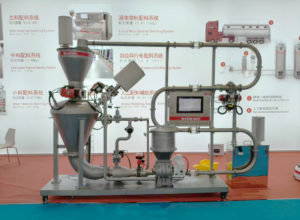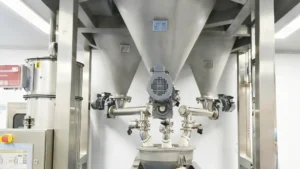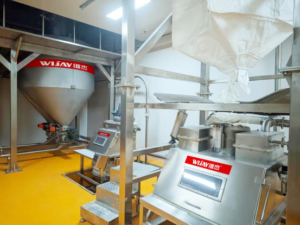
In the production lines of the food, plastic chemical, and new materials industries, powder and granular materials are the “blood” of production. However, the “vessels” responsible for conveying this “blood”—the pneumatic conveying system design—often directly determine production line efficiency and product quality. Many companies frequently encounter “invisible killers” in actual production, such as pipeline blockages, material degradation, equipment wear, and excessive energy consumption.
We understand that a scientific pneumatic conveying system design requires a deep understanding of material characteristics, precise calculation of fluid dynamics, and overall consideration of the entire production process. This article will delve into how to solve your most troublesome on-site problems starting from the design source.
I. Pain Point Analysis: The “Acute Suffering” Caused by Unreasonable System Design
When designing a pneumatic conveying system, a lack of in-depth investigation into material properties and process requirements often leads to the following four core pain points:
1. Pipeline Blockage: The Biggest “Shutdown” Risk
Blockage is the most common and troublesome fault in pneumatic conveying. When the design airflow velocity falls below the material’s “saltation velocity,” the material settles at the bottom of the pipeline; or at bends, material accumulates due to loss of momentum, eventually leading to complete system paralysis. This is particularly prominent when handling powders with higher humidity or strong viscosity. Frequent clearing not only consumes manpower but also causes huge downtime losses.
2. Material Degradation and Attrition: Direct Impact on Product Quality
For fragile materials or plastic masterbatches and food ingredients requiring high particle integrity, using high-speed dilute-phase conveying systems, while simple, causes collisions under high kinetic energy, leading to material breakage and the generation of a large amount of fines. This not only reduces product yield but can also lead to defects in downstream injection molding or extrusion processes. Many companies often overlook the conveying system as the “invisible killer” when product quality declines.
3. Pipeline Wear: A Bottomless Pit of Maintenance Costs
When conveying highly abrasive materials (such as silica sand, cement, certain chemical raw materials), if the design velocity is too high or the bend curvature radius is unreasonable, high-speed particles act like sandpaper, constantly scouring the inner wall of the pipeline. Typically, within weeks to months, the pipeline wears through, causing material leakage, dust dispersion on-site, environmental pollution, and safety hazards.
4. Excessive Energy Consumption: Invisible Profit Erosion
Many companies tend to increase blower power for “insurance.” However, an incorrect pneumatic conveying system design leads to a severe imbalance in the solid-to-air ratio. Dilute-phase conveying requires a huge volume of air to push a small amount of material, wasting electricity, overloading downstream dust collectors, and resulting in a significant operating cost over time.
II. The Solution: Wijay’s Core Logic for Pneumatic Conveying System Design
To solve the above pain points, scientific analysis methods and rigorous calculations must be introduced from the design stage.
1. The Foundation Before Design: Thoroughly Understand Material Characteristics
The first step in pneumatic conveying system design is not drawing, but material analysis.
- Particle Size & Distribution: Materials with a high proportion of fines have poor permeability, easily forming stationary bed flow. Design must consider turbulent velocity to prevent settling.
- Hardness & Abrasiveness: For highly abrasive materials (e.g., fiberglass, titanium dioxide), Wijay’s design solutions prioritize low-velocity dense-phase conveying and use wear-resistant ceramic linings at unavoidable bends to fundamentally extend pipeline life.
- Adhesion & Hygroscopicity: For sticky materials like sugar and milk powder, the design must consider pipe wall smoothness, as well as heat tracing or purging devices, to prevent material adhesion and blockage.
2. Choosing the Mode: The Dilute vs. Dense Phase Decision
The core of pneumatic conveying system design lies in selecting the correct conveying mode.
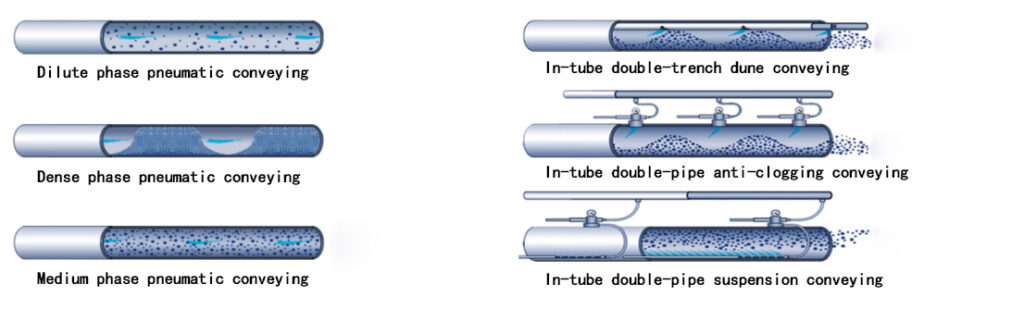
- Dilute-Phase Conveying: Suitable for most non-abrasive, non-friable materials. It operates at high speed and low pressure with high airflow, offering lower investment costs. However, Wijay’s engineers strictly control the terminal velocity to prevent product degradation caused by excessive speed.
- Dense-Phase Conveying: This is the “golden key” to solving wear and degradation problems. Wijay extensively applies this technology in projects like plastic recycling and fragile food pellets. Material moves slowly in “plugs” or “dune flow” at speeds only 1/3 to 1/5 of dilute-phase, consuming less energy and perfectly preserving material integrity.
3. The Art of Piping: The Secrets of Layout and Bends
The details of pipeline layout determine system reliability.
- Minimize Unnecessary Bends: Every bend is a potential blockage point. During design, Wijay fully communicates with the customer regarding process layout, striving to use vertical height instead of long horizontal distances with bends.
- Bend Curvature Radius: For fragile materials, use long-radius bends or “blind tee” fittings to reduce impact forces. For abrasive materials, use wear-resistant bends to concentrate wear in a specific area for easier maintenance and replacement.
4. The Wisdom of Air Source: Beware the “Brute Force” Pressurization Myth
When conveying becomes difficult, many operators’ first reaction is to “increase pressure” or “open the valve wider.” However, this is often the biggest misconception. Excessive pressure does not solve the problem but can compact the material, worsening the blockage.
Wijay’s system design emphasizes “pressure drop balance.” By accurately calculating the total frictional and local losses throughout the pipeline network, we select blowers with pressure and flow precisely matching the conveying requirements, leaving a reasonable margin but no redundancy. This ensures stable conveying while achieving maximum energy savings.
III. From Design to Reality: How Wijay Ensures System Implementation
No matter how perfect the theoretical calculations, they must withstand the test of harsh on-site conditions. Wijay establishes three lines of defense in the implementation of pneumatic conveying system design:
1. Numerical Simulation: For complex conditions, we use Computational Fluid Dynamics (CFD) software to simulate the gas-solid two-phase flow trajectory within the pipeline, predicting wear areas and vortex dead zones, and avoiding risks on the design drawings beforehand.
2. Intelligent Control System: Wijay’s systems are no longer isolated mechanical equipment. We integrate them into the Industry 4.0 framework, connecting PLCs with MES systems. The system monitors pipeline pressure, airflow velocity, and concentration in real-time. Once pressure anomalies (precursors to blockage) occur, the system automatically activates purging or vibration procedures, nipping potential faults in the bud.
3. Modularity and Scalability: Considering future production expansion needs, Wijay’s design reserves interfaces and space. Our modular design allows for easily adding new feed or discharge points without interrupting existing production.
IV. Wijay’s Commitment: More Than Equipment, A Guarantee of Efficiency
In the field of material automation conveying, the choice of every pipe and every valve embodies accumulated experience.
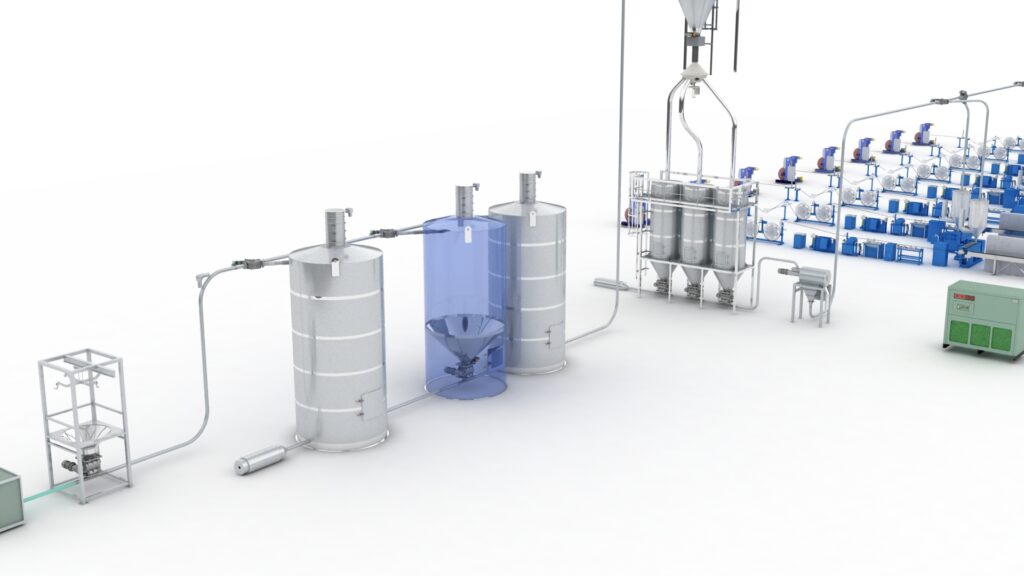
Guangdong Wijay Material Automation System Co., Ltd. has been deeply involved in the material automation industry for many years and possesses an experienced professional technical team. We have accumulated rich, successful cases in pneumatic conveying system design for the food & beverage, plastic chemical, and environmental new materials sectors. Whether it’s ultra-long-distance conveying spanning hundreds of meters, high-capacity processing of tens of tons per hour, or extremely fragile materials, Wijay can provide you with the optimal design solution.
We have successively provided turnkey material automation system solutions to world-class companies like Nestlé, BYD Group, and Jiashili Group. Our systems have not only withstood rigorous production tests but have also helped customers significantly reduce operating costs and improve product quality. At the world’s largest cable manufacturing base in the optical communication industry, the system designed by Wijay successfully handles 9 types of powder and granular raw materials over a maximum distance exceeding 600 meters, perfectly solving wire drawing and dust challenges, setting a technical benchmark for the industry.
Choosing Wijay means choosing a partner who understands processes, materials, and workflows. We believe that only by meticulously refining the design can we truly solve your future concerns, allowing your production line to operate efficiently, intelligently, and worry-free.
If you are troubled by issues with your existing conveying system or seeking the best pneumatic conveying system design solution for a new plant, please feel free to contact us. To learn more about Wijay’s material automation solutions and successful case studies, please visit our official website: www.wijaysystems.com.