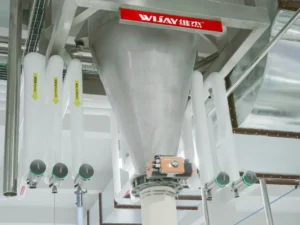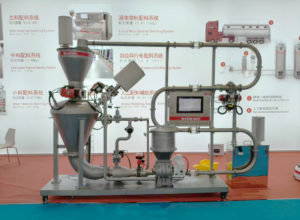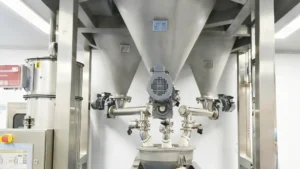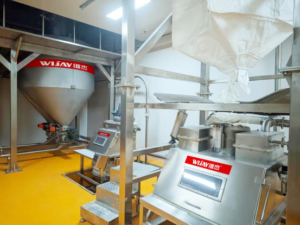
Pneumatic conveying systems are a popular choice for many powder processing companies. Not only do pneumatic conveying systems effectively move bulk powders, but they can also be customized to meet the plant’s and the material’s unique requirements.
However, pneumatic systems may not be the right choice for every application.
If you’re wondering whether a pneumatic conveying system is right for your needs, we discuss below some advantages over mechanical conveying systems, as well as some disadvantages depending on your requirements.
Pros of Pneumatic Conveying
Pneumatic conveying systems can provide a number of advantages over other conveying systems including:
1. Lower required maintenance.
Compared to mechanical conveying systems, pneumatic conveyors have fewer moving parts and typically require less maintenance.
2. Increased safety.
With fewer moving parts and less required maintenance, pneumatic conveying systems pose less danger to operators and maintenance workers.
3. Less spillage and dust leakage.
Pneumatic conveying systems transport product through an enclosed pipeline, which contains product and dust better than mechanical conveying systems.
4. Better sanitation.
Since pneumatic conveying systems use an enclosed pipeline, the risk of product contamination is greatly reduced, and the plant remains cleaner. Piping can be CIP cleaned and dried.
5. Enhanced flexibility.
Pneumatic conveying systems can be custom-designed to fit around existing powder processing equipment, taking up less space than mechanical systems and providing greater flexibility. Multiple infeed and destination points, as well as longer conveying distances, are possible.
Cons of Pneumatic Conveying
While pneumatic conveying systems are often a great choice for many powder processing systems, they’re not the perfect solution for every plant. Disadvantages may include:
1. Less energy efficiency.
Since pneumatic conveying systems use an air stream to move product, they typically require more power to achieve the required air pressure.
2. Larger dust collection system is required.
Pneumatic conveying systems require larger dust collection systems because the product needs to be separated from the conveying system’s air stream at the destination point(s).
3. Some materials are difficult to convey.
Typically, pneumatic conveying systems are great for lower density bulk powders such as flour, sugar, whey, but not for materials with larger particle sizes or those that are extremely sticky. For example, materials with high fat content are more difficult to convey by air and can cause buildup in the pipeline.
4. Not ideal for combustible bulk solids.
Combustible dusts pose deflagration and other fire hazards when suspended in the air, and an ignition source is present. Since pneumatic conveying systems use air as the primary means of moving product, special precautions must be taken.Read for more details on this topic.