A well-designed pneumatic conveying system moves materials efficiently, quietly, and reliably. A poorly designed one? It plugs constantly, damages the product, wears out elbows, and drives up maintenance costs. The difference comes down to engineering fundamentals.
If you are planning a new system or troubleshooting an existing one, understanding the core principles of pneumatic conveying system design can save you months of frustration and thousands of dollars in unnecessary repairs. Here are the five most common design mistakes we have seen across food, plastics, and chemical plants—and how to avoid them.
Why Design Matters More Than Ever
First, let us look at the numbers. The global pneumatic conveying system market was valued at approximately USD 35.78 billion in 2025 and is projected to reach USD 59.19 billion by 2034, growing at a CAGR of 5.87%. Other research places the market at USD 33.95 billion in 2025, with growth to USD 44.03 billion by 2030. This expansion is driven by rising industrial automation, stricter safety regulations, and the need for dust-free material handling.
But here is the catch: while the market grows, so does the complexity of materials being conveyed. From fragile food ingredients to abrasive minerals and heat-sensitive plastics, modern production lines demand systems designed with precision. Off-the-shelf solutions rarely work. Pneumatic conveying system design must be tailored to your specific material properties and plant layout.
Mistake #1: Choosing the Wrong Conveying Phase
The most fundamental decision in pneumatic conveying system design is selecting between dilute phase and dense phase conveying. Get this wrong, and nothing else matters.
Dilute phase conveying suspends particles in a high-velocity airstream. It is the most common approach, favored for its simplicity and ability to handle high volumes over long distances. Positive pressure systems, which dominate over 60% of the market, are often used in dilute phase applications. Dilute phase works well for rugged, free-flowing materials that can withstand impacts.
Dense phase conveying, by contrast, moves materials in slow-moving slugs or plugs at lower velocities. It is the fastest-growing segment, with a projected CAGR of 5.98%. Why the growth? Manufacturers increasingly handle fragile, abrasive, or blended materials that cannot survive dilute phase velocities. Dense phase minimizes degradation and wear.
The fix: Test your material. If it is friable, abrasive, or prone to segregation, design for dense phase from the start. Retrofitting a dilute system for dense phase later is expensive and often impractical.
Mistake #2: Poor Pipe Routing and Bend Placement
Pipe layout seems simple—just connect point A to point B, right? Wrong. Poor routing is a leading cause of line plugs and premature wear.
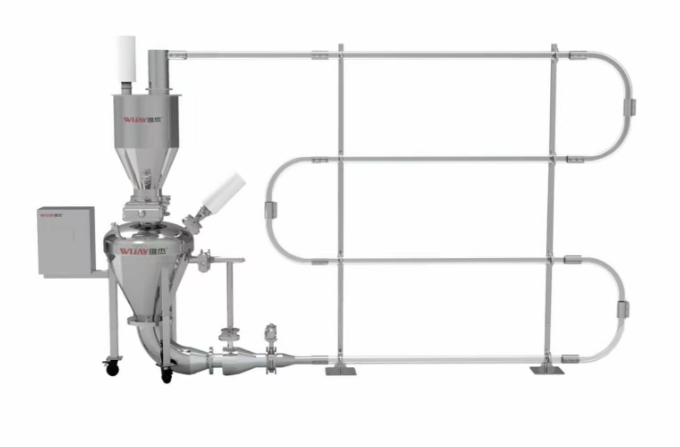
Industry experts have established clear rules. Avoid a horizontal-to-vertical bend in the first 20 feet of the system. This is the acceleration zone, where material is still gaining speed. A long-radius bend here allows material to settle on the sloped section, slide backward, and accumulate—starting a plug.
Avoid multiple bends in series. Every direction change consumes energy and increases velocity requirements. If you must have multiple bends, use an acceleration zone (about 20 feet of straight pipe) between the second and third bends.
Avoid upward-sloping lines where saltation can occur. A sloping line requires a higher air velocity than a horizontal line to keep material suspended. If the angle exceeds about 20 degrees during saltation, material slides backward—a phenomenon called refluxing—and must be reconveyed, wasting energy and risking plugs.
The fix: Map your routing carefully. Minimize bends, especially in the acceleration zone. Use short-radius bends for horizontal-to-vertical transitions in the first 20 feet if you cannot avoid them entirely.
Mistake #3: Incorrect Air Volume and Velocity Assumptions
“When in doubt, add more air.” This is perhaps the most common—and most dangerous—assumption in pneumatic conveying.
More air does not necessarily solve a plug. Airflow moves from higher pressure to lower pressure, expanding and accelerating along the line. If a plug occurs in the first 50 feet, you might need a higher air volume at the feed point. But if material was initially entrained and the system had adequate volume, the problem lies elsewhere—perhaps in line configuration or air leakage.
Conversely, excessive velocity causes its own problems. Research shows that abrasive wear increases significantly at velocities above 3,000 feet per minute. High speed also degrades fragile materials, generates fines, and increases energy consumption.
The fix: Design for the minimum conveying velocity that keeps your material suspended—not the maximum. Use variable frequency drives to adjust air volume based on actual demand. Monitor pressure drops and velocity profiles, not just guesses.
Mistake #4: Ignoring Air Leakage
Air leaks are silent productivity killers. They rob the system of conveying air, reduce velocity at the feed point, and cause unexpected plugs.
In pressure systems, check for worn rotary airlocks, leaking diverter valves, and holes in the line. A worn airlock rotor with increased clearances allows compressed air to escape backward. A non-seating diverter valve can cause plugs 20 to 40 feet downstream—material follows the straight path, but air leaks into the divert leg, and material eventually deposits on the line bottom.
In vacuum systems, air leaks are harder to detect because they draw air inward—you will not see dust escaping. But a leaking coupling or worn airlock reduces air volume at the feed point, causing plugs in the initial section.
The fix: Include leak detection in your maintenance routine. Monitor pressure differentials. Inspect rotary valves, diverter valves, and couplings regularly. If a system that once worked well develops problems, look for worn components first.
Mistake #5: Overlooking Material Properties and Changes
Here is a hard truth: your material changes. Moisture content varies. Particle size distribution shifts. New suppliers bring different flow characteristics. If your pneumatic conveying system design does not account for this variability, you will chase problems forever.
Sticky or cohesive materials absorb moisture and compact, leading to blockages. Friable materials break into fines, which then segregate, accumulate, and cause flow stoppages downstream. Materials that once conveyed beautifully in a dilute phase may now require a dense phase due to formulation changes.
The fix: Design with flexibility. Include air boosters along horizontal sections or high-resistance areas to manage variability. Install monitoring systems that track pressure, velocity, and material flow in real time. And when changing materials or suppliers, test the new material before committing to full-scale production.
The Business Case for Getting Design Right
These design principles are not academic. They have a direct financial impact.
- Reduced downtime: Every hour of unplanned plug clearing is lost production.
- Lower maintenance: Proper velocity and bend design extend pipe and component life.
- Consistent quality: Gentle handling preserves particle integrity, reducing rejects.
- Energy savings: Optimized air volume cuts compressed air costs significantly.
- Safety compliance: Enclosed, well-designed systems eliminate dust hazards, helping you meet OSHA and local regulations.
The market trends confirm this: rising automation, stricter workplace safety rules, and the growth of battery and EV material processing are all driving demand for better-designed systems. Companies that invest in proper engineering upfront spend less on fixes later.
Why Wijay Gets Design Right
Since 2012, Wijay has focused exclusively on material automation. Headquartered in Songshan Lake, Dongguan, we operate over 40,000 square meters of manufacturing space plus a dedicated 2,000-square-meter R&D center. Our team holds more than 100 patents and software copyrights, earned through continuous innovation and partnership with Zhejiang University of Technology.
We have earned ISO9001 quality management, ISO14001 environmental management, and intellectual property management certifications. These are not wall decorations—they are operational standards that guide every project.
The market recognizes our expertise. In the 2022 QYR global research report on automatic central supply systems, Wijay ranked among the world’s leading manufacturers. The Guangdong Electronic Information Association confirmed our domestic market share at 15.2% in 2022. These figures reflect real trust from real customers across food, plastics, chemicals, and new energy industries.
When you partner with Wijay, you are not buying generic equipment. You are getting a decade of experience, proven engineering, and a pneumatic conveying system design tailored to your specific material, layout, and production goals.
Ready to avoid these common mistakes in your next project?
Visit our official website to explore our solutions: https://wijaysystems.com/solutions/