The Hidden Cost of Moving Your Ingredients
Walk into any food processing facility built before 2010, and you will likely see the same sight: mechanical conveyors—augers, bucket elevators, and belts—grinding away, moving flour, sugar, and grains from storage to production.
Now look closer. See the dust settling on nearby equipment? Notice the maintenance crew cleaning up spills? Observe the labor hours spent hauling bags from the warehouse?
These seemingly minor inefficiencies are silently eroding profit margins. In an era where food safety regulations tighten yearly, and labor costs soar, the way you move ingredients from Point A to Point B is no longer just a logistical detail—it is a competitive advantage.
This is why a growing number of food manufacturers—from bakeries in Shanghai to snack producers in Chicago—are retiring their mechanical dinosaurs and embracing a cleaner, smarter alternative: pneumatic conveying.
The Mechanical Conveying Trap: Five Signs Your System Is Falling Behind
Before exploring solutions, let us diagnose the problem. If your facility relies on traditional mechanical conveyors, you may recognize these symptoms:
The Dust Cloud Problem
Open mechanical systems are inherently leaky. Every time flour or cocoa powder transfers from one belt to another, a fine mist of product escapes into the air. This is not just wasted material; it is a safety hazard. Grain dust is explosive. According to international safety data, food dust explosions, while catastrophic, are entirely preventable with enclosed handling.
The Sanitation Nightmare
Augers and belts have nooks, crannies, and moving parts that trap material. When you switch from processing wheat flour to rye, or from white sugar to brown sugar, how confident are you that the previous product is completely gone? Cross-contamination risks loom large, especially for facilities handling allergens.
The Labor Drain
Someone must empty those 25kg bags. Someone must sweep those spills. Someone must disassemble those conveyors for cleaning. In a tight labor market, manual material handling is the single greatest drain on operational efficiency.
The Recipe Inconsistency
Your mixer expects flour at a precise rate. But mechanical conveyors, especially augers, deliver material in pulses. This surge leads to inaccurate batching, forcing operators to overcompensate with expensive ingredients or, worse, send inconsistent product out the door.
The Space Squeeze
Mechanical conveyors eat floor space. They run at angles, requiring long footprints. In urban facilities where every square meter costs money, this is an expensive luxury.
What Modern Food Processors Actually Need
If you are planning a new line or retrofitting an old one, your goals likely extend beyond simply “moving stuff.” Here is what today’s production managers are really chasing:
Absolute Product Purity: Zero tolerance for foreign material. Zero cross-contamination.
Labor Independence: Systems that run unattended, freeing workers for higher-value tasks.
Recipe Precision: Delivering ingredients to the mixer or weigh hopper with pharmaceutical accuracy.
Facility Safety: Eliminating dust explosion risks and improving indoor air quality.
Flexibility: The ability to feed multiple destinations from a single source without complex manual valve turning.
The Pneumatic Difference: Clean, Precise, Enclosed
This is where pneumatic conveying comes into play. Unlike mechanical systems that use moving parts to push material, pneumatic systems use air to push (or pull) material.
The Technology Explained Simply
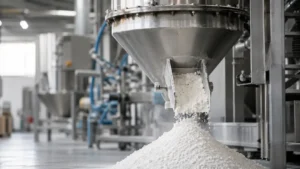
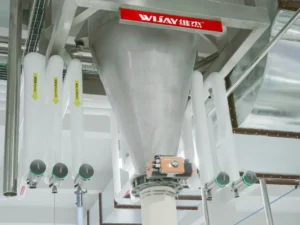
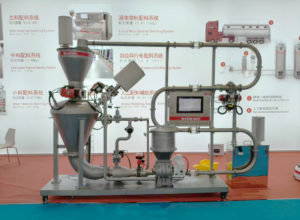
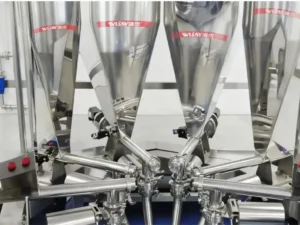
Imagine a network of stainless steel pipes running through your facility—like plumbing, but for dry ingredients. At one end, a feeder introduces material into the airstream. At the other end, a receiver separates the material from the air. In between, the material flows, fully enclosed, at high speed.
There are two primary flavors:
Pressure Systems: Push material from a single source to multiple destinations. Ideal for long distances and high throughput.
Vacuum Systems: Pull material from multiple sources to a single collection point. This is the gold standard for food applications. Why? Because vacuum systems are inherently leak-proof. If there is a breach, the vacuum sucks air in, preventing dust from escaping into the plant.
Why Vacuum Conveying Dominates Food Processing
For applications involving human consumption, cleanliness is king. Flour pneumatic conveying using vacuum technology offers distinct advantages:
Hygienic Design: No moving parts in the airstream mean less wear, less heat, and less risk of contamination.
Gentle Handling: Fragile materials such as coffee beans or high-protein flour blends are conveyed at controlled velocities to prevent degradation.
Easy Cleaning: Systems can be designed for quick disassembly or equipped with Clean-in-Place (CIP) capabilities—essential for dairy powders or infant formula.
Application Spotlight: Solving Real-World Challenges
The versatility of pneumatic technology means it solves different problems for different sectors.
Bakeries and Flour Mills
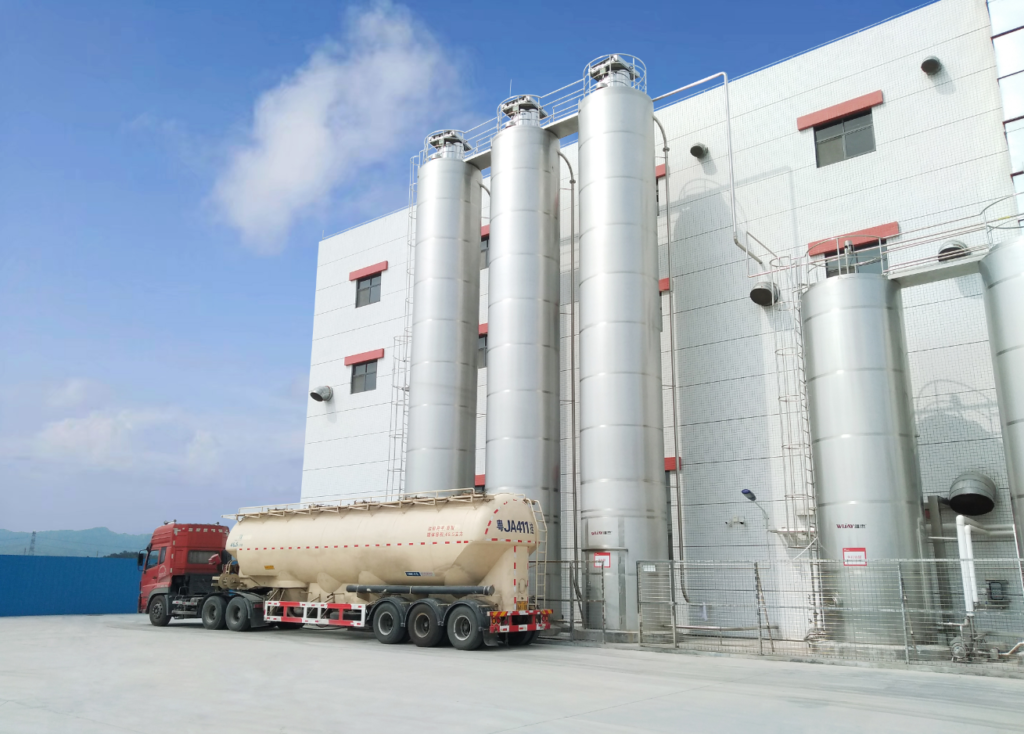
Handling flour is notoriously difficult. It is cohesive, aeratable, and explosive. Flour pneumatic conveying systems solve this by using dense phase vacuum technology. The flour moves in slow-moving plugs, like a sausage through a casing, rather than suspending it in high-speed air. This prevents heat buildup and maintains the flour’s baking properties.
Result: Consistent dough, no dust, and happy bakers.
Seasoning and Spice Manufacturers
Imagine conveying granular MSG, salt, or chili flakes without breaking them. Traditional augers crush granules, altering flavor release and appearance. Pneumatic systems, designed with low-velocity settings, transport these delicate particles intact.
Result: Beautiful, whole granules that command premium pricing.
Breweries and Distilleries
Malted barley, wheat, and rice must move from silos to the mash tun gently. Crushed grain destroys efficiency. Vacuum conveying systems transfer these grains without damage, preserving the husk integrity essential for filtration.
Result: Higher yields and clearer wort.
Snack Food and Confectionery
From sugar dusting on donuts to cocoa powder for chocolate coatings, fine powders are everywhere. Air conveying systems equipped with explosion venting and static grounding ensure these combustible materials move safely.
Result: Compliance with safety regulations and zero fire risk.
Engineering Excellence: What Sets a Great System Apart
Not all pneumatic systems are created equal. A poorly designed system will plug, degrade product, and consume excessive energy. A well-engineered system runs quietly, efficiently, and reliably for decades.
The Art of System Design
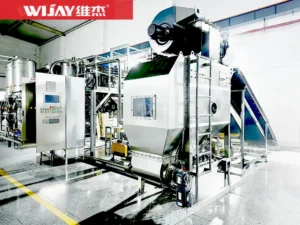
True expertise lies in matching the conveying method to the material. This is where companies like Wejie distinguish themselves. With decades of experience integrating systems across food, chemical, and plastics industries, the approach is methodical:
Material Analysis: Is it fragile? Abrasive? Does it pack under pressure? The answers dictate velocity, pipe size, and air mover selection.
Process Integration: The conveyor does not exist in a vacuum. It must interface seamlessly with upstream silos and downstream weigh hoppers, mixers, and packaging machines.
Controls and Automation: Modern systems talk to each other. When the mixer calls for flour, the system knows exactly which silo to draw from and precisely when to deliver it.
The Weigh Hopper Connection
Critical to any automated batching system is the weigh hopper. This vessel receives material from the pneumatic line and measures it with high-precision load cells. The goal: deliver ingredients at the right time, in the right dose, to the right process. When integrated with a pneumatic system, the weigh hopper becomes the brain of the operation, ensuring recipe fidelity batch after batch.
The Bottom Line: Efficiency You Can Measure
Switching from mechanical to pneumatic conveying is not just about modernization; it is about measurable ROI.
Labor Savings: One pneumatic system can replace two or three workers per shift manually handling bags.
Material Savings: Enclosed systems eliminate dust losses. For expensive ingredients like milk powder or spices, this payback alone can justify the investment within months.
Maintenance Reduction: With fewer moving parts, pneumatic systems require significantly less maintenance than mechanical conveyors.
Quality Improvement: Consistent delivery to the weigh hopper means consistent product quality, reducing waste and customer complaints.
Conclusion: Future-Proof Your Material Handling
The food industry is moving toward automation, hygiene, and precision. Mechanical conveyors, while familiar, are relics of a past era when labor was cheap and regulations were lax.
Today’s competitive environment demands better. Whether you are handling delicate flour for artisanal bread or abrasive sugar for high-speed packaging, modern pneumatic conveying systems offer a path to cleaner, safer, and more profitable production.
As a leading system integrator, WIJAY provides end-to-end solutions—from the initial site survey to final commissioning. We understand that your recipe is your secret sauce. Our job is to ensure every gram of every ingredient arrives exactly where it should, exactly when it should, exactly as it should.
The question is no longer whether you can afford to upgrade your conveying system. The question is whether you can afford not to.