In the world of bulk solids handling, the difference between operational efficiency and costly downtime often lies in the quality of the initial engineering. An inadequately designed system leads to product degradation, line blockages, and exorbitant energy bills. At Wijay Systems, we specialize in data-driven pneumatic conveying system design that prioritizes material integrity and energy efficiency. Whether handling fragile food ingredients or abrasive minerals, the engineering methodology determines the return on investment.
The Fundamentals of Pneumatic Conveying System Design
A successful pneumatic conveying system design begins not with pipe sizing, but with a deep understanding of the material itself. As detailed in authoritative industry guides, key decisions hinge on material properties such as particle size, shape, density, and air-retention capabilities. These characteristics dictate whether a system operates in a dilute or dense phase.
The design procedure must account for several critical variables:
- Conveying Distance and Pipeline Geometry: Pressure drop calculations must account for straight pipe length and, crucially, the number of bends. Research indicates that 90-degree bends significantly disrupt flow, causing particle acceleration and pressure loss, necessitating careful layout planning.
- Airflow and Velocity: Maintaining an optimal conveying air velocity is paramount. Too low, and material saltates or blocks the line; too high, and energy consumption soars while fragile products degrade. The goal is to find the “minimum conveying velocity” for a given material.
- System Configuration: Open vs. closed loop, pressure vs. vacuum—the choice impacts component specifications and operational safety.
Dilute Phase vs. Dense Phase: Matching Design to Material
Selecting the correct flow mode is central to pneumatic conveying system design.
- Dilute Phase (Suspension Flow): Ideal for non-fragile, general materials. Particles are suspended in the air stream at high velocity. While simple, this mode can cause erosive wear in bends and degrade friable products.
- Dense Phase (Non-Suspension Flow): This mode pushes material through the line at low velocity, either as slugs or in dune flow. It is the preferred solution for the food and chemical industries because it minimizes degradation and reduces component wear. Systems utilizing pressure vessels and external air injection are often specified for long-distance, gentle conveying.
Advanced Design Methodologies: Simulation and Scaling
Modern engineering has moved beyond guesswork. At Wijay Systems, we employ advanced simulation tools and scaling techniques to reduce design risk. As noted in leading technical literature, using logic diagrams and scaling parameters based on conveying characteristics allows engineers to confidently predict how a material will behave in a full-scale system.
We utilize coupled simulation methods (such as EDEM-Fluent) to analyze gas-solid two-phase flow. This allows us to visualize particle trajectories, identify potential vortex zones in bends, and optimize internal pipe geometry—such as the use of optimized bellows for re-mixing flow after a vertical lift—before a single pipe is cut.
Case Studies: Proven Performance Across Industries
Theory is validated by practice. Our commitment to precision engineering in pneumatic conveying system design has made us a trusted partner for global manufacturing leaders. We do not offer off-the-shelf products; we provide custom-engineered solutions.
Nestlé: Precision in Hygienic Design
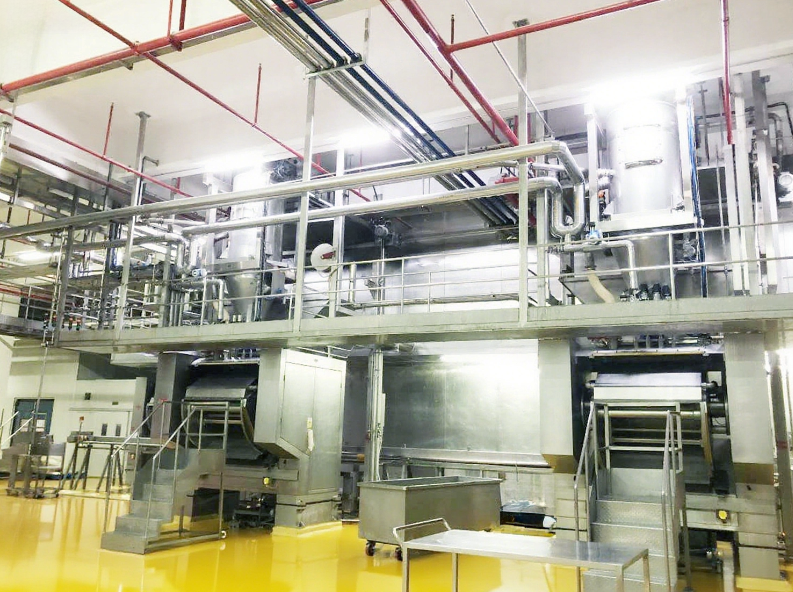
For Nestlé’s confectionery operations, Wijay Systems engineered a dense-phase conveying solution specifically addressing the challenges of handling delicate, sugar-based materials. The system maintains low-velocity flow across the entire conveying path, eliminating the frictional heat that causes sugar meltage in conventional designs. All contact surfaces feature sanitary finishes with minimal crevices, supporting the rigorous cleaning protocols required in global food manufacturing. The result: consistent preservation of particle size and zero contamination risk across multi-shift operations.
Hsu Fu Chi: Long-Distance Material Integrity
One of Asia’s largest confectionery manufacturers, Hsu Fu Chi, required a solution for transferring sugar-based materials over extended distances without degradation. Our engineering team designed a system with multiple pressure-control zones that maintain dense-phase flow characteristics even under challenging elevation changes. By precisely calculating the air-to-material ratio at every pipeline segment, we eliminated the fines generation that previously affected product quality. The installation has operated continuously since commissioning with zero line blockages—a testament to robust design methodology.
Garden: Reliability in High-Volume Flour Handling
For heritage bakery brand Garden, flour handling reliability directly impacts production uptime. Their previous system suffered from inconsistent feed rates during peak demand, causing downstream mixer starvation. Wijay Systems redesigned the intake and distribution network using computational fluid dynamics modeling to optimize airflow patterns. The new configuration eliminates bridging at feed points and maintains precise delivery pressure regardless of demand fluctuations. Production data shows 100 percent availability during peak periods, directly supporting Garden’s expanded production capacity.
The Wijay Systems Difference: Engineering for Efficiency
What sets Wijay Systems apart is our focus on total lifecycle cost. While many vendors look only at the initial price, our pneumatic conveying system design focuses on:
- Energy Optimization: By precisely calculating the required air flow rate and pressure, we avoid the industry standard of “over-designing” with oversized blowers. Properly designed systems can reduce power consumption by 20-30%.
- Component Longevity: We specify components—from diverters to feeding devices—based on the material’s specific wear characteristics. For abrasive minerals, this means hardened bends; for food, it means tool-free sanitary inspections.
- Scalability: Our designs are modular. As your production grows, our systems can be uprated and extended without requiring a complete overhaul .
Conclusion: Precision Design Leads to Profitable Operations
Pneumatic conveying system design demands expertise spanning material science, fluid mechanics, and mechanical engineering. Getting it right requires both theoretical knowledge and practical experience across diverse applications. At Wijay Systems, we bring both—validated by successful installations for global industry leaders, including Nestlé, Xu Fuji, and Garden.
Are you planning a new processing line or troubleshooting an existing bottleneck? Don’t leave your material handling to chance.
Visit wijaysystems.com today to consult with our engineering team and discover how we can optimize your bulk material handling operations.