In the plastic products processing industry, the conveying of plastic pellets is the first critical step in the production process. Many plastic product companies have reported to us: “We’ve purchased the best injection molding machines or extruders, so why isn’t our final yield improving? Why is our workshop always filled with dust? Why does our production line frequently shut down due to material blockages?”
In reality, the root of the problem often lies not with the production equipment itself, but with the seemingly simple front-end plastic pellet conveying system.
The “Three Major Pain Points” of Traditional Conveying Methods
After extensive contact with numerous plastics and chemical companies, we’ve found that traditional mechanical conveying or outdated pneumatic conveying systems commonly suffer from the following issues:
- Raw Material Damage and Dust Pollution: High-speed, high-pressure airflow conveys quickly but also causes intense collisions between plastic pellets and between pellets and the pipe wall. This leads to pellet breakage and generates significant dust. Dust not only pollutes the workshop environment and harms employee health but can also directly cause defects like “black spots” or “fish eyes” in subsequent injection-molded products, severely impacting product appearance and quality.
- Frequent Blockages and High Maintenance Costs: Particularly for hygroscopic plastic pellets (such as PA, PET, etc.), they easily adhere to the pipe wall during humid seasons, leading to blockages. Once a blockage occurs, the entire production line must stop. Manually hammering pipes and clearing clogs is not only time-consuming and labor-intensive but also results in significant downtime losses.
- Inaccurate Dosing Leading to Waste: Manual weighing or simple volumetric metering often results in significant errors, leading to unstable mixing ratios. This not only wastes expensive raw materials but also causes inconsistent product quality between batches.
How to Address the Root Cause? Wijay Has Its Own Solution.
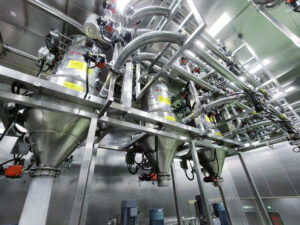
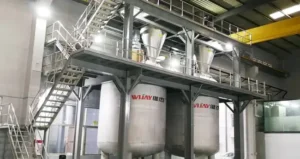
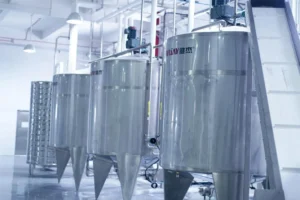
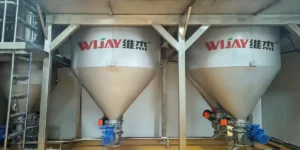
In response to the pain points mentioned above, the plastic pellet conveying system designed by Wijay is not merely a collection of equipment but a customized solution based on fluid dynamics and material characteristics.
We have moved away from traditional designs that purely pursue high speed, adopting instead dense-phase conveying technology. By precisely controlling the conveying airflow velocity, plastic pellets move slowly in a “plug-like” formation within the pipeline, akin to cork plugs. The benefits of this approach are immediately apparent:
- Solving Pain Point 1: Reducing Breakage Rate
With minimal relative motion between pellets and a reduction in conveying speed by over 60%, the breakage rate can be controlled to within 0.1%. This means that raw materials which would otherwise turn into dust and waste can now integrally become part of the qualified product, directly saving the company considerable material costs. - Solving Pain Point 2: Eliminating Blockages
The system’s built-in intelligent pipeline cleaning logic and targeted pipe diameter design ensure smooth conveyance even in humid weather or when handling materials with high viscosity. Furthermore, the fully enclosed conveying environment leaves “no escape” for dust, significantly improving workshop cleanliness and facilitating easier environmental compliance checks. - Solving Pain Point 3: Enabling Precise Dosing
Integrated with high-precision weighing modules, Wijay’s plastic pellet conveying system achieves dynamic metering accuracy within ±0.5%. Every step, from the storage silo to the production equipment, is precisely controlled, ensuring formula stability and consistent quality for every batch of plastic products.
Why Choose Wijay?
In the field of automated material handling, plastic pellets are among the most deceptively complex materials to manage. With a wide variety ranging from free-flowing PP/PE to brittle, easily broken glass-fiber reinforced materials, their characteristics differ vastly.
Guangdong Wijay Material Automation System Co., Ltd. has extensive experience in this industry for many years. We understand the “temperament” of each type of plastic pellet intimately. We don’t offer one-size-fits-all equipment; we provide plastic pellet conveying systems designed to solve your specific, real-world problems. With a wealth of successful cases in the plastic and chemical industries, whether it’s the overall planning for a new factory or the automation upgrade of an old production line, the Wijay team leverages its extensive experience to deliver stable, efficient, and low-damage conveying solutions.
Want to learn how our system can help you reduce losses and improve your yield? Please visit our official website, wijaysystems.com, for more case studies and information.