The Challenge of Moving Powder at Scale
If your manufacturing operation handles bulk powders, you already know the challenges. Powder doesn’t flow like liquid. It cakes. It clogs. It creates dust. And when you need to move thousands of kilograms per hour, these small problems become big bottlenecks.
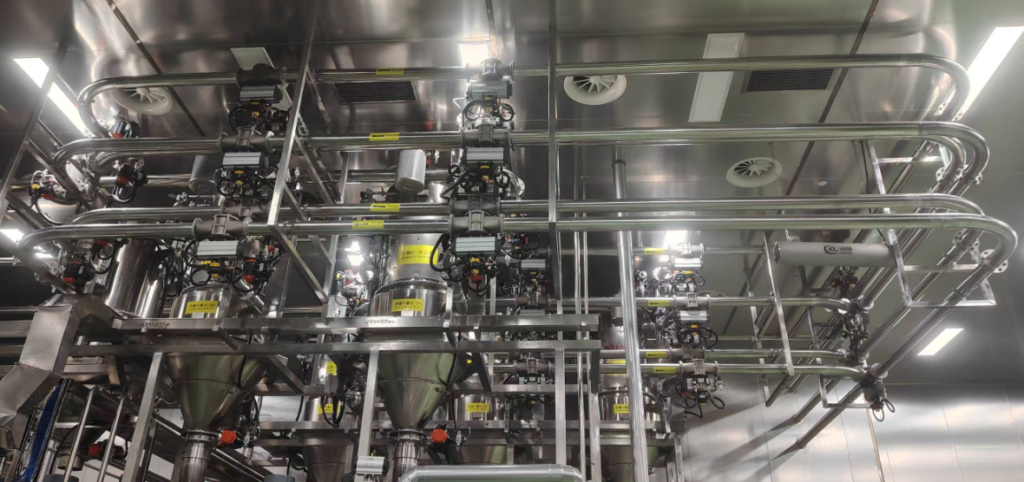
Many manufacturers start with basic equipment—manual handling, simple screw conveyors, or low-capacity pneumatic systems. These work fine at small scales. But as production volumes grow, the limitations become obvious:
- Labor costs increase as more people are needed to move the material
- Inconsistent feed rates disrupt downstream processes
- Product degradation affects quality
- Dust and spillage create safety hazards and cleanup costs
- Unplanned downtime from blockages or equipment failure
This is where high-capacity powder conveying systems enter the picture. They are not just larger versions of small equipment. They are engineered solutions designed specifically for the demands of continuous, high-volume production.
What Makes a Conveying System “High-Capacity”?
The term gets used loosely, so let’s be specific. A true high-capacity powder conveying system typically handles:
| Parameter | Typical Range |
|---|---|
| Throughput | 2,000 – 50,000+ kg/hour |
| Distance | Up to 500+ meters |
| Materials | Powders, granules, flakes, blends |
| Applications | Food, chemical, plastic, battery materials |
But numbers alone don’t tell the whole story. What matters is whether the system maintains consistent performance while handling your specific material.
Material Properties Matter More Than You Think
Here is something many equipment buyers overlook: the same powder from different suppliers can behave completely differently in your conveying system. Particle shape, moisture content, and size distribution all affect flow.
A system designed without testing your actual material is a system designed to fail. The engineering question is not “can we move this powder?” but “how does this powder want to move, and what system design matches its behavior?”
This is why experienced system designers always start with material testing. They need to know:
- Will the powder fluidize well?
- What minimum velocity keeps it moving without dropping out?
- How much will it degrade when it hits a bend?
- Will it stick to pipe walls under certain conditions?
Two Main Approaches to High-Capacity Conveying
When you need to move large volumes of powder, you generally choose between two pneumatic conveying methods.
Dilute Phase Conveying
In dilute phase systems, material is suspended in high-velocity air. Think of it like a snowstorm inside a pipe. The material moves quickly—typically 20 to 40 meters per second—and is continuously airborne.
Best for: Free-flowing, non-fragile materials
Pros: Simple design, lower capital cost, good for multiple pickup points
Cons: Higher energy use, more degradation, more pipe wear
Dense Phase Conveying
Dense phase systems move material at lower velocities—1 to 8 meters per second. The material moves in slugs or plugs, pushed by compressed air. It is gentler and more energy-efficient.
Best for: Fragile, abrasive, or blended materials
Pros: Less degradation, lower energy costs, less wear
Cons: Higher pressure requirements, more complex controls
Many high-capacity installations use both approaches for different parts of the process, depending on the material and distance involved.
The Economics of High-Capacity Systems
Let’s talk about money. A properly engineered high-capacity system costs more upfront than basic equipment. But the total cost of ownership tells a different story.
Labor Savings
A system handling 5 tons per hour replaces multiple people moving material with forklifts or dumping bags. Those labor savings add up quickly—often enough to justify the investment within two to three years.
Material Savings
Open handling of powders creates waste. Spills, dust collection losses, and degraded material all represent money leaving your facility. Enclosed conveying eliminates most of this waste. One WIJAY client in the baking industry saves over three million yuan annually in material procurement and waste reduction after installing an automated system.
Quality Improvements
When material degrades during conveying, your product quality suffers. Inconsistent particle size affects everything from dissolution rates to final product appearance. Gentle conveying preserves your material’s specifications, which means consistent quality for your customers.
Uptime Reliability
Downtime is expensive. When your conveying system blocks or fails, production stops. High-capacity systems designed with your material in mind run reliably for years with minimal unscheduled maintenance.
Signs You Need to Upgrade Your Conveying System
How do you know when it is time to invest in a high-capacity system? Watch for these indicators:
You are adding shifts but not increasing output. If your conveying equipment cannot keep up with demand, you are leaving money on the table.
Your maintenance crew spends more time clearing blockages than doing preventive work. Chronic blockages are not bad luck—they are a design problem.
Product quality varies between batches. If degradation or inconsistent feeding affects your final product, your conveying system is part of the problem.
You are planning new production lines. Adding capacity is the perfect time to evaluate whether your current material handling approach scales appropriately.
Dust is everywhere. Open handling creates safety risks and housekeeping costs that a closed system would eliminate.
What to Look for in a System Supplier
Not all conveying equipment companies are created equal. When you invest in a high-capacity system, you are buying years of production reliability. Here is what matters when choosing a partner.
Material Testing Capability
The best systems are designed around your material, not the other way around. A supplier should have laboratory facilities to test the actual product and validate design parameters before building anything.
Industry Experience
Different industries have different requirements. Food processing demands sanitary design and easy cleaning. Chemical handling requires wear resistance and often explosion protection. Battery materials need precise batching and contamination prevention. Look for experience in your specific application.
Engineering Depth
Building a high-capacity system requires mechanical, electrical, and controls engineering working together. The supplier should handle all aspects in-house or through trusted long-term partners.
References You Can Trust
Any supplier can claim capability. Real proof comes from installations running successfully in similar applications. Ask for references and, if possible, visit operating installations.
WIJAY: A Practical Approach to High-Capacity Conveying
Since 2012, Guangdong WIJAY Material Automation System Co., Ltd. has focused on one thing: engineering reliable systems for manufacturers who need to move powder at scale. Based in Dongguan’s Songshan Lake high-tech zone, the company combines a 2,000-square-meter R&D center with an equivalent production facility.
The Engineering Philosophy
WIJAY’s approach is summarized in four Chinese characters: 极简设计,极致可靠. This translates to “minimalist design, ultimate reliability.” The idea is simple: the best system is not the one with the most features, but the one that runs reliably day after day with minimal intervention.
This philosophy shows up in practical ways:
- Components are selected for durability, not just initial cost
- Controls are intuitive enough that operators can use them effectively
- Maintenance access is designed in from the start
- Every system starts with material testing, not assumptions
Real Projects, Real Results
The proof of any engineering approach is in operating installations. Here are two examples from WIJAY’s project portfolio.
Baking Industry Application
A client needed to supply 220 tons of raw materials daily to multiple production lines. Materials included flour, starch, sugar powder, and liquid ingredients. WIJAY designed an integrated system handling feeding, storage, temperature control, screening, conveying, weighing, and formula management.
After implementation, the client achieved annual savings exceeding three million yuan in material procurement, waste reduction, and labor costs. Investment payback came in under three years.
Plastics Processing Application
This project involved ten production lines handling over ten different powder and granular materials. Bulk densities ranged from 0.3 to 3.8 kilograms per liter—a 12-fold variation that would challenge conventional systems. Some materials absorbed moisture and tended to stick, creating blockage risks.
WIJAY engineers applied ACU technology combined with dual-pipe conveying to eliminate blockages entirely. Special dual-rotation mixers achieved 120 tons per day of high-uniformity blended material.
Industry Recognition
WIJAY’s capabilities have earned recognition from demanding clients, including Nestlé, Garden Group, Futong Group, and BTR New Energy. The company ranked among the global top ten central supply system manufacturers in a 2021 industry report and holds over 50 patents and software copyrights.
Quality certifications include ISO9001, ISO14001, and intellectual property management systems. Components are sourced from established European manufacturers with century-long track records.
Making Your Decision
Investing in a high-capacity powder conveying system is a long-term decision. It affects your production capacity, operating costs, product quality, and worker safety. Getting it right requires careful evaluation of your needs and potential suppliers.
Questions to Ask Potential Suppliers
When you evaluate conveying equipment companies, ask these questions:
- “What specific experience do you have with materials similar to ours?”
- “Will you test our actual material before finalizing the design?”
- “Can we speak with references who have similar installations running?”
- “How do you handle infeed control to prevent overloading?”
- “What is your approach to maintenance access and serviceability?”
The Value of Getting It Right
A well-designed high-capacity system runs reliably for decades. It pays for itself multiple times over through labor savings, material conservation, and quality improvements. It frees your team to focus on production instead of firefighting material handling problems.
The upfront cost difference between a properly engineered system and a basic alternative is small compared to the operating cost difference over the system’s life. Cheap equipment is expensive in the long run.
Conclusion
High-capacity powder conveying systems are not just about moving material faster. They are about moving material better—with less waste, less degradation, less downtime, and less labor. They transform material handling from a bottleneck into a competitive advantage.
The key is matching the system to your material and your production requirements. This requires engineering depth, material testing, and experience across different applications. These are exactly the areas where WIJAY focuses its resources.
If your production volumes are growing, if you are tired of clearing blockages, if dust is a constant problem, or if you are planning new capacity, it is time to look seriously at what a properly engineered high-capacity system can do for your operation.
The right system, designed around your needs, will run reliably for years and pay for itself many times over. That is not just equipment—that is a foundation for growth.